
If you are planning a trip to Jamaica, reconnecting with your heritage, or simply fascinated by one of the Caribbean’s most vibrant tongues, learning core Jamaican Patois phrases is the single best investment you can make.
Jamaican Patois, also known locally as Patwa or Patwah and referred to as Jamaican Creole by linguists, is an English-based creole language with significant West African influences. It is spoken by over 3 million inhabitants on the island and by Jamaicans across the diaspora globally.
From a relaxed roadside greeting to a sharp proverb that stops a conversation in its tracks, Patois is the living heartbeat of Jamaican culture, and this guide gives you 50 phrases to start speaking it with confidence.
What Is Jamaican Patois?
Before you dive into the phrases, a few minutes of context will sharpen your ear and help the words stick.
A Language Born of History
The origins of Jamaican Patois can be traced back to the 17th century, during the era of British colonization, when enslaved Africans were brought to Jamaica to work on sugar plantations.
These enslaved Africans were forced to learn English, the language of their colonizers, but they retained elements of their native languages, which they blended with English to communicate.
The result was a creole language that drew vocabulary primarily from English but was heavily influenced by West African languages such as Akan, Igbo, and Yoruba.
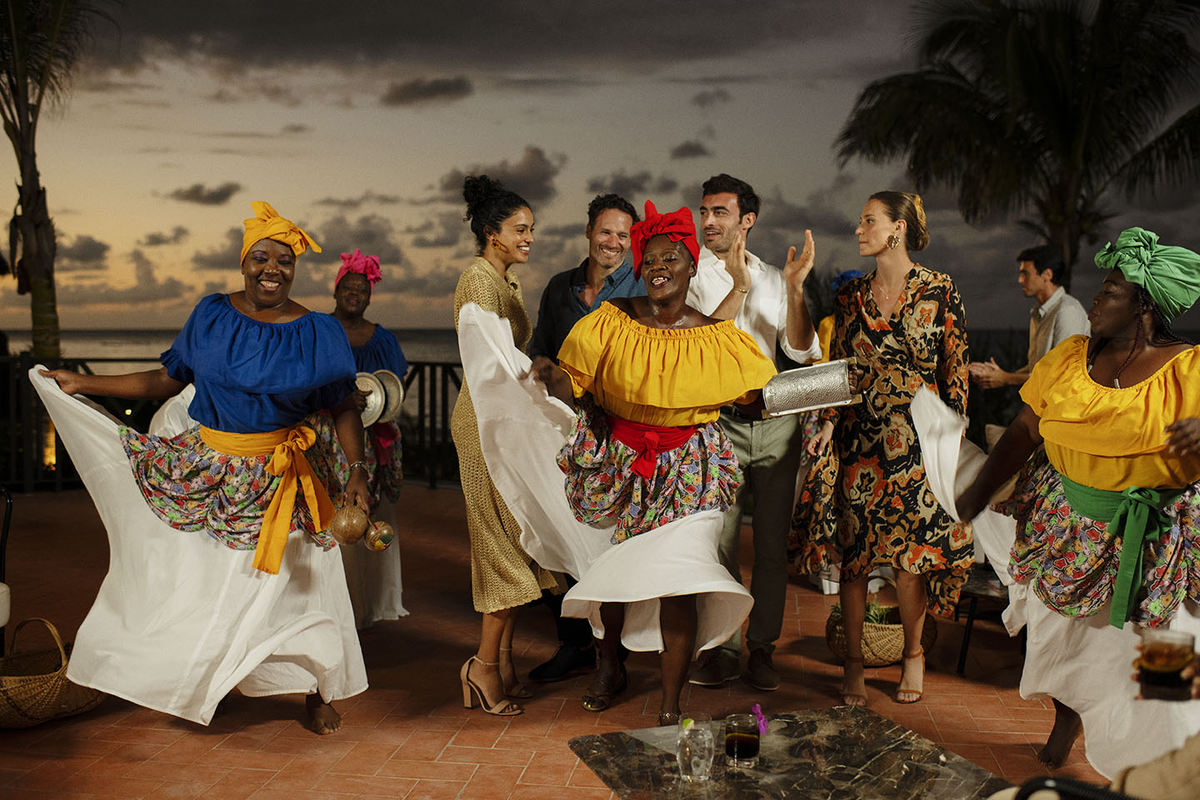
Enslaved Africans shared their speech and a “pidgin” was formed, a way of communicating based on a combination of features from different languages.
The pidgin continuously evolved to meet the needs of the people. Eventually the grammar regularized and it became a full-fledged language, at which point linguists refer to it as a “creole.”
The Spanish colonization period (1494 to 1655) left some linguistic traces, but it was the British colonial era (1655 to 1962) that most significantly influenced Jamaica’s language development. Jamaican Patois was also influenced by the Taino indigenous languages spoken in Jamaica.
Prior to the arrival of Europeans and Africans, the Taino people were the original inhabitants of Jamaica, and their language had a significant impact on the initial development of Jamaican Patois.
Not Broken English
A critical point for any learner: Patois is not a degraded or simplified form of English. Jamaican Patois is not broken English. It is a fully developed creole language with its own grammar, phonetics, and vocabulary.
While it borrows many English words, they often have distinct meanings and usages in Jamaican context. Jamaican Patois is significantly influenced by African languages, extending beyond vocabulary to include elements like rhythm, tone, and syntax.
Notably, it features serial verbs, tonal emphasis, and a lack of subject-verb agreement, which are characteristics aligned with African linguistic patterns.
A Global Language
For much of Jamaica’s history, Patois was stigmatized as “broken English” or considered inferior to standard English.
However, the cultural renaissance that accompanied Jamaica’s independence movement in the 1960s began to change attitudes toward Patois.
Reggae music, literature, and other art forms embraced Patois as an authentic expression of Jamaican identity, helping to elevate its status.
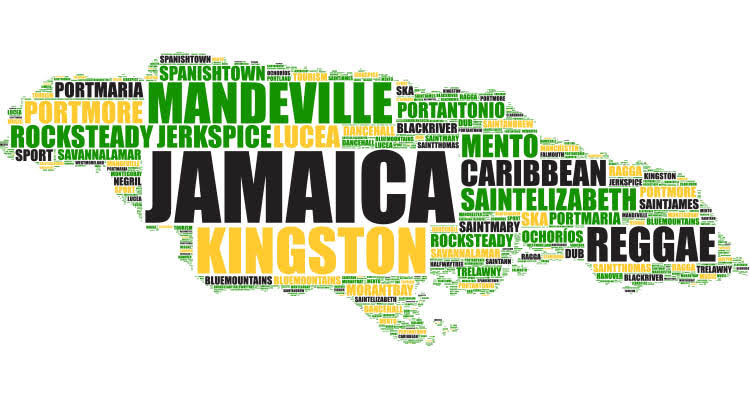
The most important driving force behind the global spread of Jamaican Creole outside the diaspora is the worldwide success of Jamaican reggae and dancehall music.
Over time, dancehall phrases slipped into global youth culture, influencing slang in cities from London to New York.
Today, there is a growing movement to recognize Patois as an official language of Jamaica, alongside English, reflecting a broader shift towards valuing linguistic diversity and cultural heritage.
Key Grammar Rules to Know Before You Start
Understanding a few structural principles will help you move beyond memorized phrases into genuine comprehension.
1. The verb “to be” is often dropped.
The vocabulary of Jamaican Patois is largely derived from English, but its pronunciation, grammar, and syntax are heavily influenced by African languages.
For example, the use of the verb “to be” is often omitted in Jamaican Patois, a characteristic found in many West African languages.
2. One verb form covers the present tense.
Jamaican Patois is a distinct language that has its own grammar that differs from standard English. Its grammatical structure is simpler, with fewer verb tenses and no articles or plural forms.
In Patois, there is only one verb form for the present tense, regardless of the number of subjects. This means that the verb “run” would be the same for “I run” and “we run.”
3. The “H” rule.
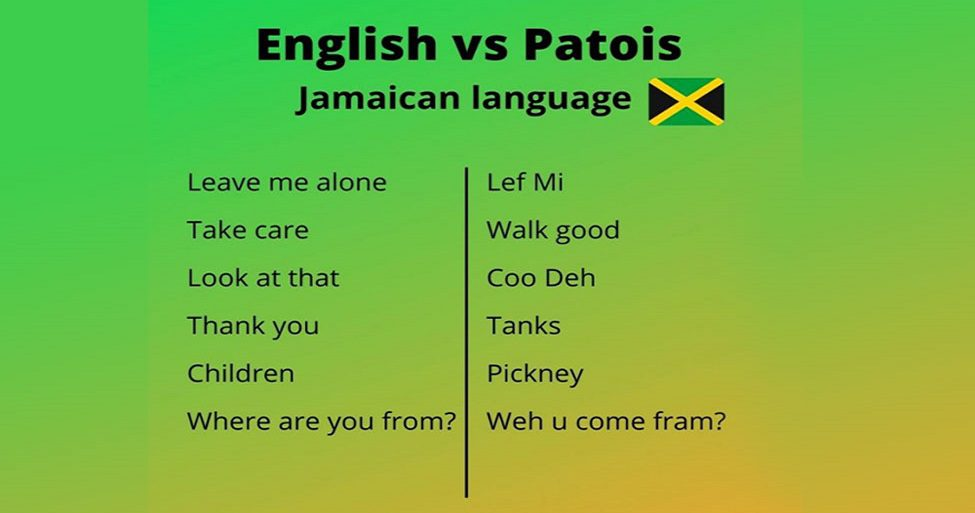
Patois has a unique rule for the letter “H.” Words that begin with an “H” in English usually drop it in Patois, so “head” becomes “ed.” Conversely, words that start with a vowel will often gain an “H,” so “all” becomes “hall.”
4. The “TH” becomes “D.”
Some English consonants change their pronunciation in Jamaican Patois. For instance, the “th” sound can often become a “d” sound, like in the word “the,” which might sound like “di.”
5. Vowels are stretched and musical.
Jamaican Patois uses a different vowel system than standard English. The vowels are often stretched or modified, giving the language its melodic quality.
For example, the “a” sound in words like “man” or “hand” might sound more like “ah,” similar to the “a” in “father.”
6. Pronouns work differently.
In Jamaican Patois, “dem” and “di” are frequently used as pronouns. “Dem” denotes a group of individuals, whereas “di” is used to refer to a single person or a specific thing. “Mi” replaces both “I” and “me” depending on context.
The 50 Essential Jamaican Patois Phrases
The phrases below are grouped by situation so you can find what you need quickly.
Greetings and Everyday Hellos
These are the Jamaican Patois phrases you will hear and need within the first five minutes of arriving on the island.
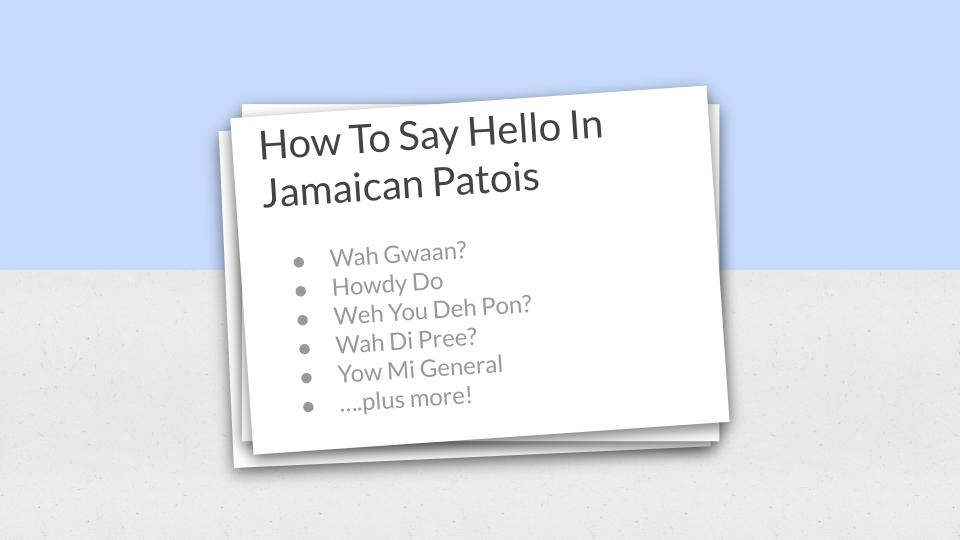
1. Wah Gwaan
The most iconic Jamaican greeting. “Wah Gwaan” translates to “What’s going on?” or “What’s up?” It is a friendly way to ask how someone is doing.
2. Mi Deh Yah
The standard reply to Wah Gwaan. While the literal translation is “I am here,” the implied meaning is “everything is ok” or “I’m doing well.”
3. Irie
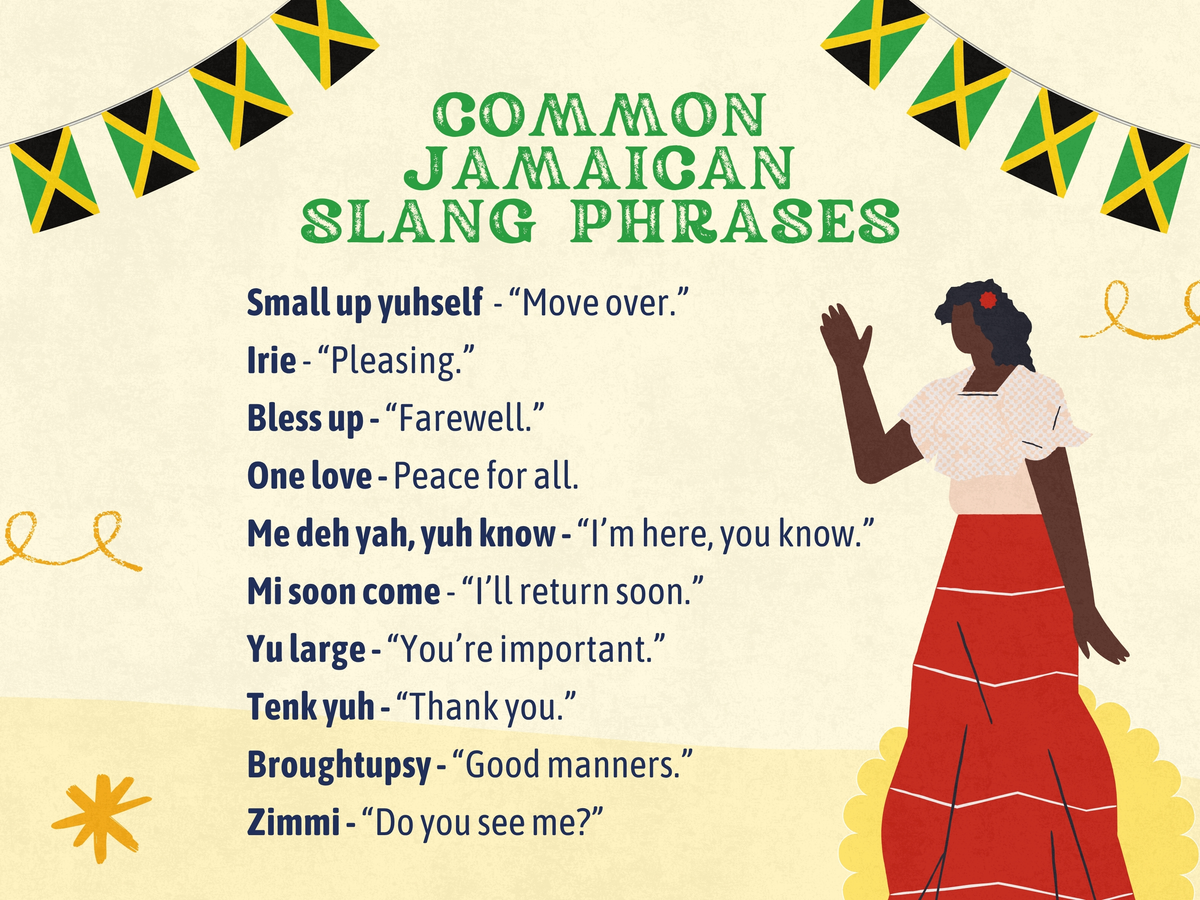
“Irie” is used to express that everything is all right, cool, or just plain good. You can use it as both a greeting response and a general expression of contentment.
4. Wah Yuh Seh
Literally, “What do you say?” Used to mean “What’s up?” or as a follow-up when you want someone to repeat or clarify what they said.
5. How Yuh Duh
The phrase “How yuh duh” means “how are you doing?” and is used as a casual greeting.
6. Nice Fi Meet Yuh
When meeting someone for the first time, it is customary to say “Nice fi meet yuh,” meaning “nice to meet you.
7. Mi Good
“I am good.” A clean, simple, confident response to any greeting.
8. Blessed
A single-word greeting or affirmation used across Jamaica to convey gratitude and goodwill.
9. Bless Up
Bless up” is the Jamaican way of saying “Have a nice day,” and the phrase is sometimes used as a greeting or goodbye. It carries with it some good Jamaican vibes, and you can use it in conversations to wish someone well.
10. Respect
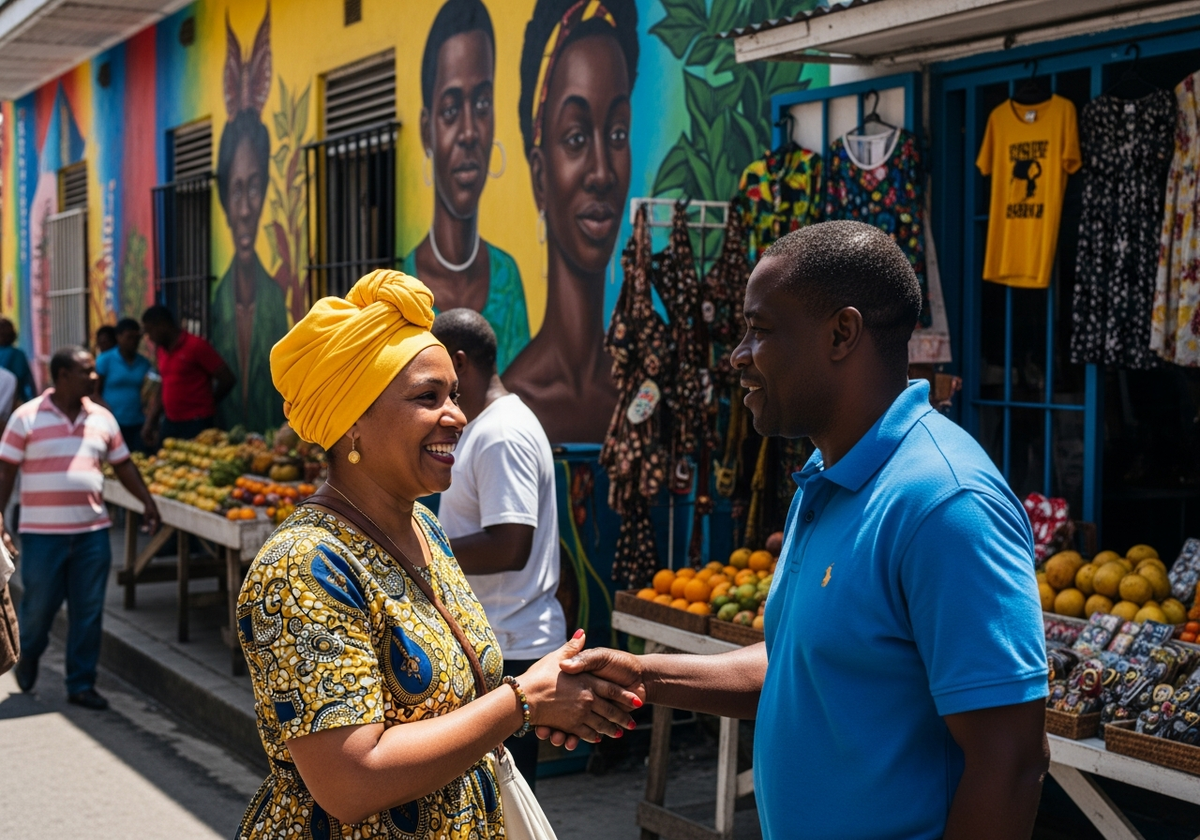
Widely used as both a greeting and a farewell, acknowledging mutual esteem. Delivered with a nod or a fist bump, it carries significant social weight.
Responses, Agreement, and Affirmation
11. No Problem
Recognized worldwide, this phrase means “no problem” and is used to express agreement or affirmation. You will hear it constantly. It reflects the island’s fundamental philosophy of ease.
12. Seen
An affirmative that means “I understand,” “I agree,” or “exactly.” It signals that a person has fully absorbed what was just said.
13. Tru
Short for “true.” A quick way to say “you are right” or “I agree completely.”
14. Fo Real
Used just like “for real” in American English: to express sincerity, disbelief, or to seek confirmation.
15. Word
Similar to “tru,” it signals agreement and is often used to close a point in a conversation.
Farewells and Sign-Offs
16. Likkle More
Meaning “see you later” or “goodbye.” For example, “Mi see yuh likkle more den” translates to “I’ll see you later then.”
17. Inna Di Morrows
Used when saying goodbye. The literal translation would be “In the tomorrows,” meaning “see you later.”
18. Walk Good
A parting blessing, equivalent to “take care” or “travel safely.” It is one of the warmest things a Jamaican can say to you as you leave.
19. Later
Used casually among friends, it functions exactly as it does in English but delivered with the characteristic Patois cadence.
20. Soon Come
Mi soon come” means literally “I’ll be right there.” However, if you are told “mi soon come,” do not be fooled. Island time is much slower than the rest of the world, and this expression should be interpreted as meaning anything from a few hours to a few days.
Getting Around and Practical Phrases
21. Small Up Yuhself
“Small up yuhself” means “Make some room” or “Excuse me.” Use this if you are trying to squeeze by someone or need a little more space. It is especially useful on crowded buses and route taxis.
22. Weh Yuh Deh
“Where are you?” A useful phrase when coordinating meetups with locals.
23. Mi Soon Come
As noted above, this means “I’ll be there soon,” though the timeline is flexible. Use it to reassure someone you are on your way.
24. Mi Waan…
“Mi waan…” means “I want…” This phrase is essential for ordering at restaurants, food stalls, or street vendors. Follow it with whatever you need.
25. Gimme Likkle More
A polite way to ask for a bit more of something, whether it is rice, sauce, or information.
26. How Much
“How much does it cost?” Straightforward enough for any market transaction. Patois speakers often shorten it further in context.
27. Weh Dat Deh
“Where is that?” A practical navigation phrase for asking about locations.
28. Mi Lost
“I am lost.” Self-explanatory and essential for any traveler.
Expressions of Emotion and State of Being
Patois is extremely expressive and musical. Tone, rhythm, and body language add depth to its meaning. A single phrase can express warmth, humor, sarcasm, or anger based on delivery.
29. Mi Glad Fi See Yuh
“Mi glad fi see yuh” means “I’m glad to see you.” It is a warm, genuine way to express happiness when meeting someone.
30. Mi Luv Yuh
Forget the plain old “I love you.” In Jamaica, it is “Mi luv yuh.” Pronounced like “me love you,” it works for romantic partners, family, and close friends alike.
31. Mi Vex
“I am angry” or “I am upset.” Useful for communicating displeasure without escalating a situation.
32. Mi Nuh Business
“I do not care” or “It is none of my business.” Often said to disengage from gossip or drama.
33. Mi Tired
“Mi tired” after a long day of exploring can elicit sympathy and understanding from locals.
34. Lawd Have Mercy
A common exclamation of shock, surprise, or disbelief. It functions much like “Oh my God” in Standard English and is deeply embedded in everyday speech.
35. A So It Go
“That is how it is” or “such is life.” A philosophical shrug used when accepting an unfortunate situation.
People, Identity, and Social Life
36. Bredda
“Bredda” refers to a close male friend. It is a casual and affectionate way of saying “brother” in Jamaican Patois. Not limited to biological brothers; it denotes any trusted friend.
37. Sista
The female equivalent of “bredda.” An affectionate term for any woman you share a close bond or camaraderie with.
38. Yaad
“Yaad” is a term of endearment for home. It is short for “yard,” but in Jamaica, it means much more: it represents your home, your roots, your comfort zone. “Yardie” refers to a Jamaican person, especially one who has moved abroad.
39. Ginal
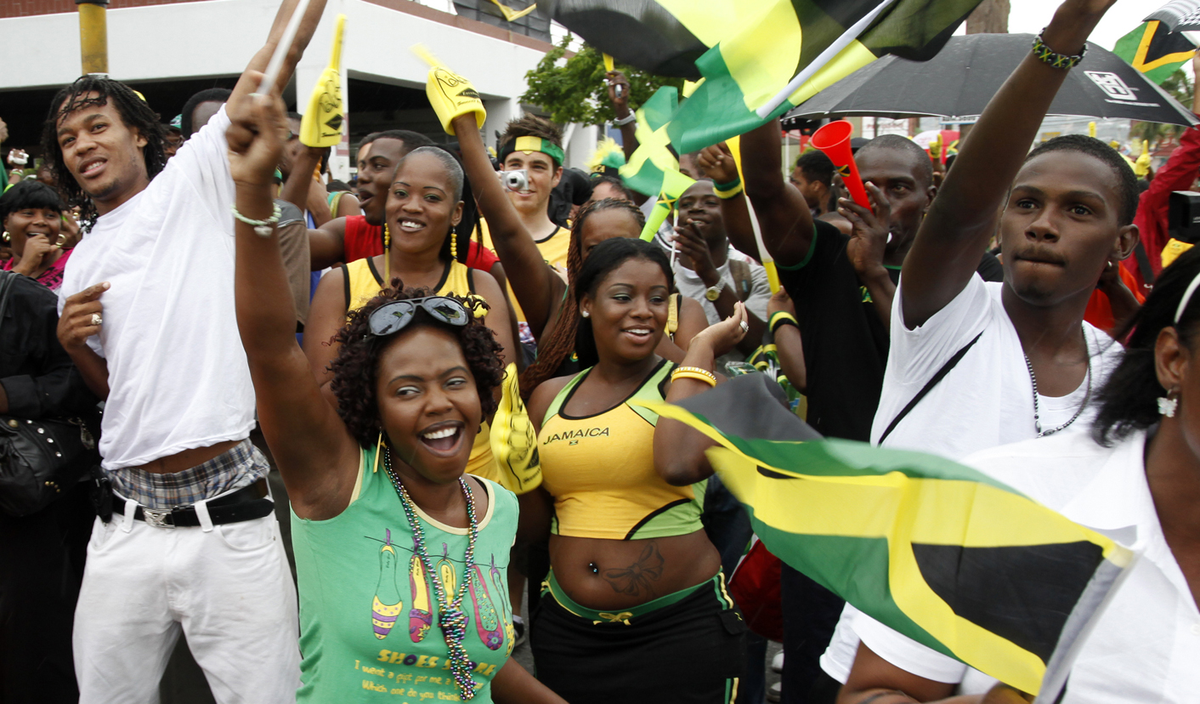
A trickster or con artist. The word “ginal” derives from Akan (Ashanti Twi), related to words meaning someone who is not taken seriously or a con-man. Call someone a ginal only if you mean it.
40. Duppy
“Duppy” means ghost and is believed to derive from Akan or Ga languages. You will encounter this word in Jamaican folklore, proverbs, and even popular music.
Rastafarian-Influenced Phrases
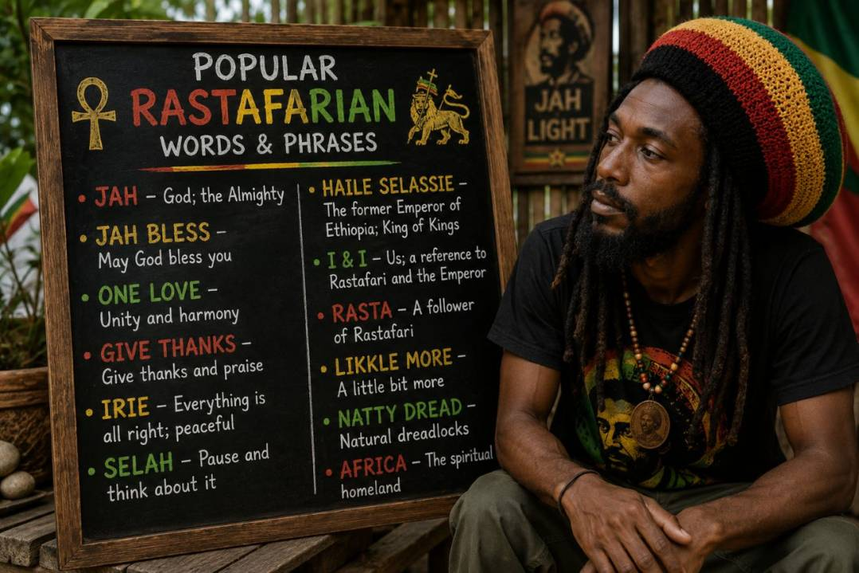
Patois became a symbol of national identity, especially during the rise of the Rastafarian movement in the 1930s.
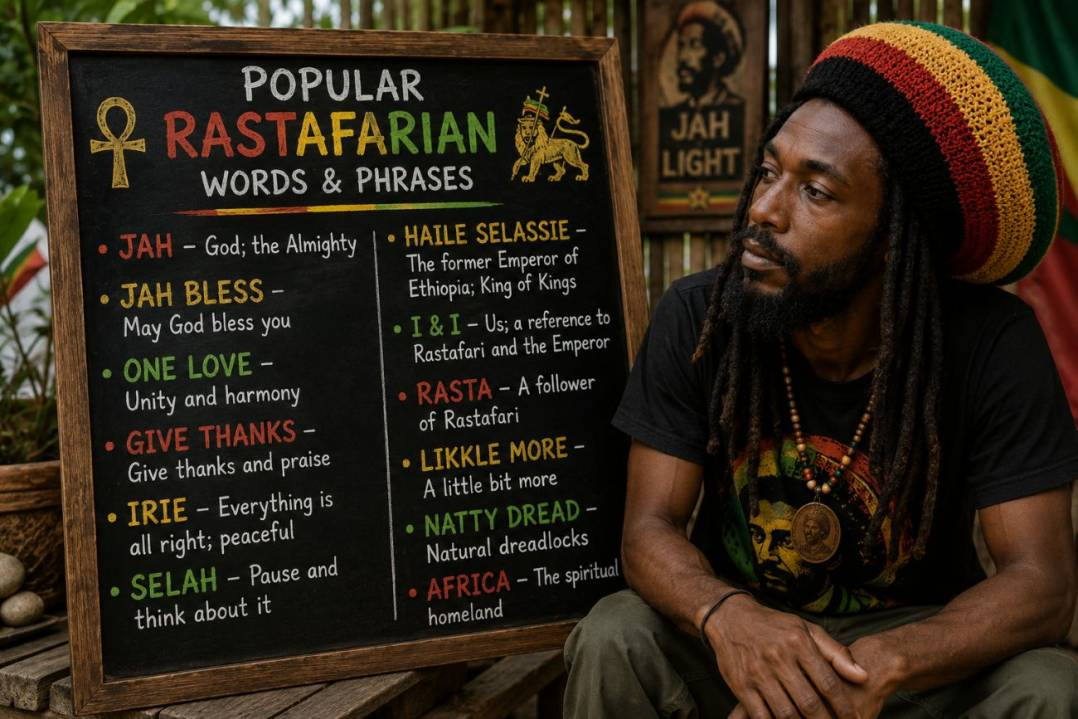
Rastafarians embraced Patois as a way to reject colonial oppression and assert their African heritage. Their linguistic contributions added a distinct philosophical layer to everyday speech.
41. Ital
Rastas coined terms like “I-tal” (meaning natural or vital). It refers to a clean, natural way of living, including a plant-based diet.
42. I and I
“I-and-I” means “we,” emphasizing unity. It replaces the pronoun “we” and stresses the divine connection between all people.
43. Overstanding
“Overstanding” means understanding, rejecting the “under” prefix as a colonial construct. To “overstand” something is to rise above it and comprehend it fully.
44. Babylon
“Babylon” refers to oppressive Western society. It is used broadly to describe any system, institution, or person perceived as corrupt or oppressive.
45. Give Thanks
A Rastafarian-rooted expression of gratitude that has entered mainstream Jamaican speech. It is far more emphatic than a simple “thank you.”
Proverbs and Cultural Wisdom
One of the most charming aspects of Jamaican Patois is its collection of humorous and playful sayings. These expressions, often passed down through generations, carry wisdom, humor, and cultural insight.
46. Every Mickle Mek a Muckle
Literally meaning “every little bit counts,” this proverb emphasizes that small efforts or contributions add up over time. It is often used in discussions about saving money, working on projects, or building relationships.
47. If Yuh Want Good, Yuh Nose Haffi Run
Translating to “no pain, no gain,” this idiom reminds listeners that effort and sacrifice are necessary to achieve meaningful results.
48. Sake a Mout Fish Get Ketch
This is a play on words that people who engage in fishing will understand. It literally means that talking too much can get you into trouble. A warning to choose your words with care.
49. Mash Up
“Mash up” is common in Jamaica and across the entire Caribbean. It can be used as a verb or adjective to mean “demolish/demolished” or “destroy/destroyed.” You will likely hear this used in reference to something that is in disarray, and the term also carries some level of disbelief or shock.
50. Nyam
“Nyam” means to eat and may come from Twi or Fula. It is one of the most frequently used African-derived words in everyday Patois and shows up in expressions like “Mi nyam already” (I have already eaten).
How to Improve Your Pronunciation
Knowing the phrases on paper is only half the job. Patois is extremely expressive and musical; tone, rhythm, and body language add depth to its meaning. Here is how to train your ear effectively.
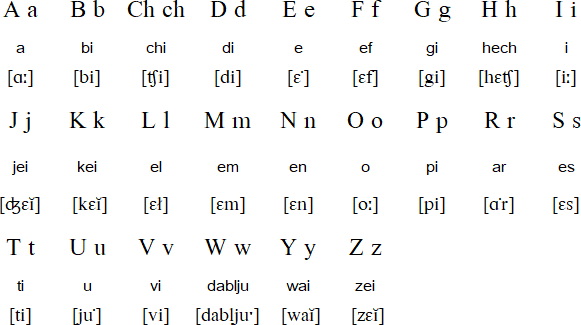
Listen to native speakers first.
The best way to master pronunciation is to listen to native speakers. Reggae music is an excellent resource. Pay attention to how artists pronounce words and try to mimic them.
Use online resources.
YouTube is also a strong resource. Search for Patois lessons or interviews with Jamaicans to get a feel for the rhythm and intonation of the language.
Practice writing, too.
For generations, Patois was passed down purely through spoken word. It was the voice of the people, shared in songs, stories, and daily life.
Because it was an oral language for so long, trying to learn it from social media or random internet comments can be incredibly confusing. Seek out consistent resources and stick to a reliable spelling framework when writing.
Embrace the continuum.
Because Patois is a hybrid of languages, it exists on a continuum that ranges from more dissimilar to less dissimilar to English.
The terms for the classes in the continuum are the acrolect (variations closest to English), the basilect (variations furthest from English), and the mesolect (variations in between). Beginners will likely hear and speak closer to the acrolect, and that is perfectly fine as a starting point.
Why Learning Jamaican Patois Phrases Matters
In Jamaica, language is more than just communication. It is culture, rhythm, and attitude wrapped into one. Arriving with even a handful of phrases signals respect, cultural curiosity, and genuine interest in the people, not just the beaches. Jamaican Patois enables unique forms of expression that capture the island’s history, values, and worldview.
Throughout history, Patois has served as a form of resistance against colonial domination and a symbol of cultural resilience. Shared language creates bonds among Jamaicans both on the island and throughout the diaspora.
Whether you are a first-time visitor, a member of the Jamaican diaspora reconnecting with your roots, or a language enthusiast, these 50 Jamaican Patois phrases give you a solid foundation.
Use them with warmth, humility, and a willingness to laugh at yourself when the pronunciation needs work. That spirit alone will earn you more respect than any perfect accent ever could.