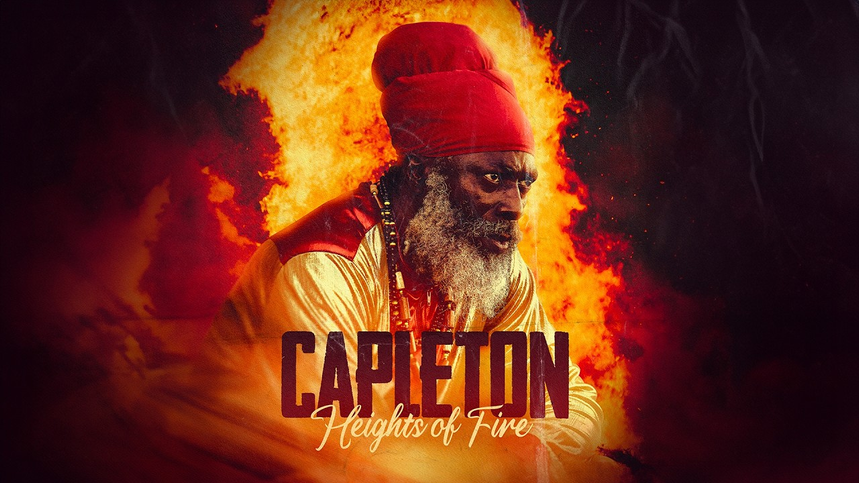

Capleton has never been subtle about his favorite element, and his new album title keeps that streak going.
“Heights of Fire” arrived on June 26, 2026, announced the way many veteran acts now release music: a Facebook post, a streaming link and three fire emojis doing most of the talking.
The post tells fans to stream the record on iTunes, Spotify and “all digital stores,” with a bfan.link smart link sending listeners to their platform of choice. That’s all the artist shared up front. The announcement doesn’t list tracks, producer credits or guest features.
For anyone who has followed the man known as The Fireman, the title reads almost like a mission statement.
Fire imagery has run through his catalogue for decades, from “More Fire” in 2000 to “Still Blazin'” in 2002, “Reign of Fire” in 2004 and “I-Ternal Fire” in 2010.
Born Clifton George Bailey III in St. Mary, Jamaica, Capleton came up through the early ‘90s dancehall scene before his music turned hard toward Rastafari.
That shift reshaped his sound, trading slackness for the chant-driven, militant “bun fire” delivery that became his signature.
His crossover moment came in the mid-’90s with “Tour,” the track that carried him well beyond Jamaica. It appeared on his 1995 album “Prophecy,” released through Def Jam’s African Star imprint, during a period when major labels were actively courting dancehall talent.
That history makes this rollout interesting. A quiet digital drop with a single social post is a long way from the label campaigns of his Def Jam and VP Records years.
For longtime supporters, the minimal promo is part of the appeal: the music goes straight from the artist to the people who’ve stuck with him.
There’s another side to Capleton’s legacy that has always shaped how his releases land. In the 2000s, some of his earlier lyrics were targeted by LGBTQ rights campaigners, and that led to cancelled shows overseas.
Some listeners still bring that history to his work, while his core audience has continued to treat him as one of roots-conscious dancehall’s most committed voices.
Where “Heights of Fire” fits in that story isn’t clear yet. Without a published tracklist or credits, it’s too early to say whether the album leans toward the raw sound-system energy of his ‘90s and early-2000s run or the more meditative roots style he has explored since. Whether it brings back familiar collaborators or introduces newer names is also unknown.
What is clear is that Capleton is still putting out full-length projects at a time when many of his peers have shifted to occasional singles or nostalgia sets.
The link is live, the album is out, and listeners are only now starting to work through what the Fireman brought this time.