
Every hip-hop origin story eventually lands in a Bronx rec room in the summer of 1973.
Follow the bassline back far enough, though, and you end up somewhere else: the yards of Kingston, where a boy named Clive Campbell watched men wheel giant speaker boxes into a dancehall on handcarts.
The story of DJ Kool Herc and Jamaica is the story of how sound system culture crossed the water and gave birth to something new.
Herc was born in Kingston on April 16, 1955, and he carried that island inheritance with him to New York.
Britannica credits him as the founder of hip-hop, the movement built on rapping, graffiti, B-boying and deejaying. The man himself has never let anyone forget where his blueprint came from.
Growing Up Between Trench Town and Franklyn Town
Herc’s first home was Trench Town, and he likes to point out that Bob Marley lived there too. His formative years also played out in Franklyn Town, where a dancehall sat close to the family’s door.
His mother was a nurse. His father was a mechanic who worked on forklifts. Young Clive’s attention, though, belonged to the dance.
He still remembers the ritual: men pushing “big boxes” inside on handcarts, and hand-painted signs nailed to lightposts announcing the next session. This was the world Coxsone Dodd helped build when he set up his Downbeat system in 1954.
Operators ran homemade rigs, often loaded onto pickup truck beds, and played American R&B alongside homegrown ska and rocksteady.
The sound system was radio, nightclub and newspaper rolled into one, and the selector was the most important man in the yard.
Herc absorbed all of it. Speaking to the Jamaica Observer in 2004, he named his influences as Prince Buster, Don Drummond, the Skatalites, Big Youth, U-Roy and Coxsone Dodd. In other conversations he has added King Stitt, Lee “Scratch” Perry and King Tubby.
“I never forget people like Prince Buster, I always remember Coxson,” he once said, and it reads less like nostalgia than a debt acknowledged.
A Kingston Kid in the Bronx
In 1967, at 12 years old, Herc moved with his family to the Bronx. His father found work at Clark’s Equipment in Queens. The adjustment was not easy.
Herc has often said it was hard to be Jamaican in the Bronx of the early 1970s, and as the Gleaner put it, being Jamaican simply was not fashionable then.
So he found other ways in. He started out as a graffiti writer with a crew called the Ex-Vandals, and took the name Kool Herc. The “Herc” came from “Hercules,” a nickname earned by his physical build.
Yet the boy who had stared at those speaker boxes in Franklyn Town never stopped thinking about sound.
Building the Herculords
What Herc eventually assembled in New York was pure Kingston engineering logic transplanted to the Bronx.
He called his system the Herculords, and he has described it as sounding like a band, loud enough to be heard from the Cross Bronx Expressway.
In a borough where most parties ran on modest home stereos, that kind of weight was a statement. The Observer summed it up plainly: he took his Jamaican sound system skills to the Bronx.
He did not do it alone. His partner on the mic, Coke La Rock, was also a Jamaican immigrant, and together they worked the crowd the way Kingston toasters always had.
The writer Wayne Marshall of Wayne & Wax draws a direct line back to King Stitt, the toaster Coxsone hired to hype the crowd and the sound, arguing that Stitt sounded like Herc and Coke.
Hear it that way and the Bronx MC starts to look like a cousin of the dancehall DJ.
August 11, 1973: The Back to School Jam
The night that changed everything began with a teenager who needed school clothes. Herc’s sister, Cindy Campbell, rented the rec room at 1520 Sedgwick Avenue, a 102 unit building, for $25.
Her brother, then 18, would supply the music. Admission was reportedly 25 cents for women and 50 cents for men.
The room held only a few hundred people, but the setup was outsized: soul and funk pumping through a Kingston-style sound system. Herc and Coke La Rock gave shout-outs over the records in the manner of reggae toasting.
As the Associated Press later described it, Herc began speaking over the beat in a way reminiscent of Jamaican toasting.
Bronx kids heard it as something brand new. Anyone raised on U-Roy would have recognised it instantly.
The Merry-Go-Round
Herc’s other great insight came from watching the floor. He noticed dancers went wildest during the percussion breaks, those short stretches where the band drops out and the drums take over.
So he bought two copies of the same record, put them on two turntables, and ran the break back and forth to stretch it out.
He called the technique the “Merry-Go-Round.” The earliest known example used James Brown’s “Give It Up or Turnit a Loose.”
The dancers who lived for those moments he called “break-boys” and “break-girls,” names that became B-boys and B-girls.
It is hard not to hear the Jamaican logic underneath: a culture of versions and dubplates, where producers stripped tunes down to drum and bass and let the riddim carry the dance.
Herc applied that instinct to American funk, and a new art form followed.
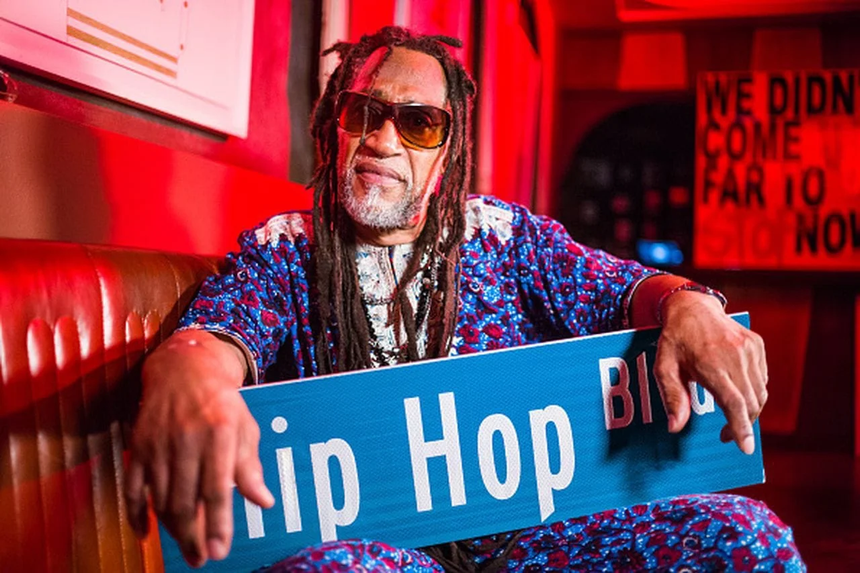
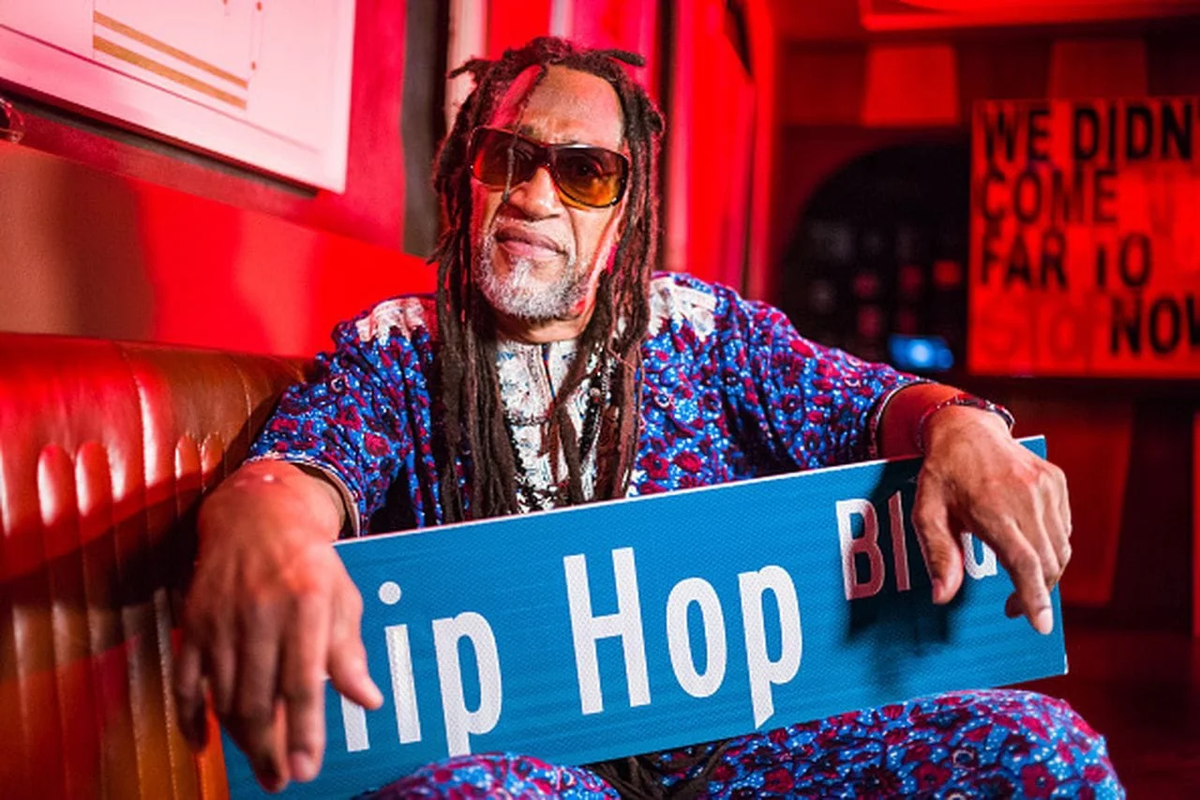
Years later, rallying to protect the building, he called 1520 Sedgwick “the Bethlehem of hip-hop culture.” In February 2016 the address was co-named Hip Hop Boulevard.
Jamaica Claims Its Son
For a long time, the Jamaican chapter of the story sat in the footnotes. That changed decisively in 2023.
Jamaica announced on Independence Day that Herc would receive the Order of Distinction in the rank of Commander, and the honour was presented on National Heroes Day, October 16, 2023.
The citation recognised his contribution to international recognition of the Reggae/DJ genre and his pioneering of hip-hop.
Weeks later, on November 3, 2023, he was inducted into the Rock and Roll Hall of Fame under Musical Influence, only the third Jamaican so honoured after Bob Marley in 1994 and Jimmy Cliff in 2010.
That August he had also appeared at Hip-Hop 50 Live at Yankee Stadium, marking half a century since the party on Sedgwick. “I never left my national heritage, it’s always been with me,” he told the Observer that year.
Why Herc’s Jamaican Story Still Matters
In August 2026, The Source marked 52 years since that back to school jam, and the date keeps getting bigger with every anniversary. What deserves equal billing is the journey behind it.
Hip-hop did not appear from nowhere. It grew from a Kingston boyhood spent among speaker boxes, toasters and selectors, carried north by a kid who felt out of place and turned that difference into a new language.
“I’m the first person who started my style of deejaying coming from Jamaica,” Herc told the Gleaner in 2020, adding, “Despite everything, I have never forgotten my roots.”
For dancehall and reggae fans, that is the real takeaway. Every time a crowd erupts on a break or an MC hypes the room, a little bit of Downbeat and Trench Town is still in the air.