

Some records announce themselves as farewells. Uprising never did. When Bob Marley and the Wailers delivered it in June 1980, it sounded like a band at full strength, ready for the biggest European tour of the year.
Yet Uprising, the last Bob Marley album released in his lifetime, carries the weight of a man settling accounts with God, with history and with his own mortality.
It was the twelfth studio album by Bob Marley and the Wailers, and it closes on a single voice and an acoustic guitar.
Eleven months after its release, Marley was gone. Listening now, it is hard to separate the music from that ending, and maybe we should not try.
This is the story of how Uprising came together, what it says, and why it still lands so hard.
Recording at Tuff Gong
The Wailers cut Uprising at home. Sessions ran from January to April 1980 at Tuff Gong Studios in Kingston, where the album was also mixed.
Production is credited to Chris Blackwell and Bob Marley, and the record came out on Tuff Gong/Island on 10 June 1980. In the UK it was pressed as Island ILPS 9596.
Making it in Kingston mattered. By 1980 Marley was the biggest star the Third World had produced, but he kept the work rooted in his own studio, with his own band and his own city around him. The partnership with Blackwell had already taken reggae onto rock radio and into stadiums.
On Uprising that partnership produced the widest stylistic range of any Wailers record, from a dancefloor crossover to a bare folk hymn.
A Record of Faith
Few Marley albums are as openly devotional. Nearly every song on Uprising speaks to his Rastafarian faith, and the running order reads like a spiritual journey.
The original ten tracks are “Coming in from the Cold,” “Real Situation,” “Bad Card,” “We and Dem,” “Work,” “Zion Train,” “Pimper’s Paradise,” “Could You Be Loved,” “Forever Loving Jah” and “Redemption Song.” Some pressings print the fourth track as “We And Them,” while CDs use “We And Dem.
The opener, “Coming in from the Cold,” sets the tone: warm, searching and quietly hopeful. “Bad Card” is the hardest thing here, a tough roots groove that reminds you this band could still grind in the old way.
“We and Dem” draws a firm line between the faithful and Babylon. “Work” builds its urgency through a countdown chant.
“Zion Train” rolls forward on a sense of spiritual destination, and “Forever Loving Jah” is about as plain a statement of devotion as Marley ever recorded.
Running through all of it is the feeling of a man looking toward something beyond the next tour date.
“Could You Be Loved”: The Crossover
Then there is “Could You Be Loved,” the album’s most surprising turn and its biggest hit. Released as a single on 16 May 1980, ahead of the album, it leans into the disco era with a choppy, insistent guitar and a rhythm built for clubs as much as for yards.
It reached No. 5 on the UK Singles Chart and No. 6 on the US Club Play chart, and it reached No. 56 on US Hot Soul Singles. That was a real foothold in Black American dance music, the audience Marley badly wanted to reach.
The song never really left. It returned to the UK chart at No. 71 in 1984 and No. 86 in 1997, and in 2024 it showed up at No. 172 on the Billboard Global 200, more than four decades after its release.
Joe Cocker covered it on his 1997 album Across from Midnight. Its message is as spiritual as anything else on the record, but it reaches you through the hips first.
“Redemption Song”: Voice and Guitar
Uprising ends with the most stripped back recording of Marley’s career. “Redemption Song” is just his voice and guitar, with no hint of a reggae rhythm anywhere.
Marley had already cut a full-band version, according to Rolling Stone, when Blackwell suggested an acoustic treatment.
Marley agreed, and the solo take became the one the world knows. The band version survived as the single’s B-side.
The words carry their own lineage. The song’s key lines come from a 1937 speech Marcus Garvey gave in Nova Scotia: “Emancipate yourself from mental slavery” and “None but ourselves can free our minds.”
Placing Garvey’s call at the close of an album this steeped in faith turned a Rasta record into a statement about liberation itself, the kind every listener could carry out into the world.
Marley seemed to sense he had found something. A few months before his death, he said of acoustic songs like this one, “I would love to do more like that.” He never got the chance.
Mutabaruka, the poet and broadcaster, would later name “Redemption Song” the most influential recording in the history of Jamaican music. Released as a single on 7 October 1980, it has outlived every chart it touched.
The Uprising Tour
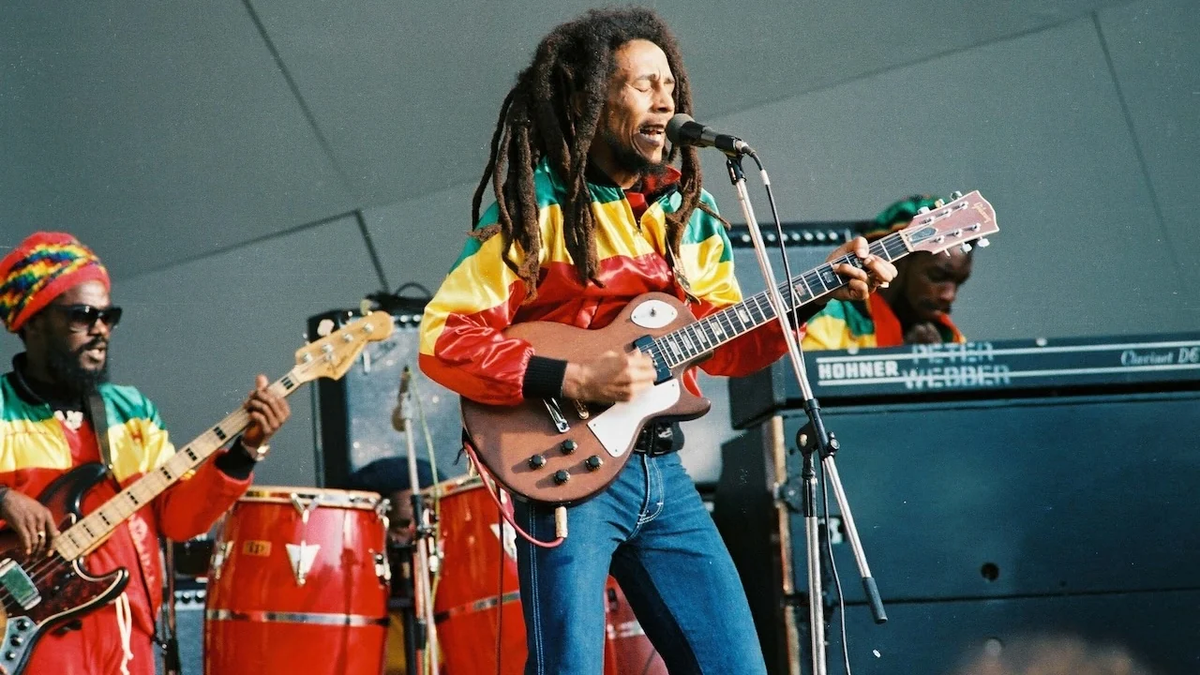
Marley took the album on the road before it was even in shops. The Uprising Tour opened on 30 May 1980 at the Hallenstadion in Zurich, the night “Redemption Song” was first performed in public.
Over 38 shows, 33 in Europe and five in the US, the tour was billed as the biggest music tour of Europe that year.
On release day, 10 June, the Wailers opened for Fleetwood Mac at the Reitstadion in Munich, a venue built for 69,000.
The cancer that would kill him was already moving. Marley had been diagnosed in 1977 with malignant melanoma under the nail of his right big toe.
He declined amputation, later had a skin graft, and by 1980 the disease had spread. On 21 September 1980 he collapsed while jogging in New York.
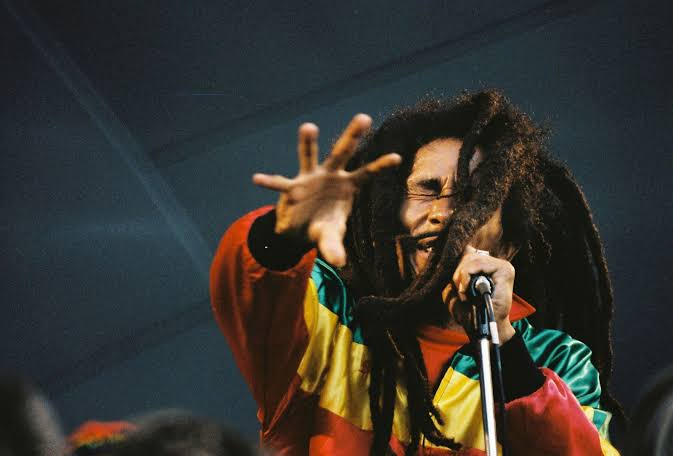
Two nights later, on 23 September, he walked onstage at the Stanley Theater in Pittsburgh for what would be his final concert.
The band behind him that night was the full family: Aston and Carlton Barrett, Alvin Patterson, Earl Lindo, Tyrone Downie, Al Anderson, Junior Marvin, and the I Threes of Judy Mowatt, Marcia Griffiths and Rita Marley.
“Coming in from the Cold,” “Work,” “Could You Be Loved,” “Zion Train” and “Redemption Song” all featured. Marley introduced that last one as “this little song.” The show was eventually released in 2011 as Live Forever.
Charts and Reissues
Uprising reached No. 6 on the UK Albums Chart, No. 45 on the US Billboard Top LPs & Tape chart and No. 41 on the US Top Soul LPs chart.
Across Europe it stayed in rotation all year, finishing 1980 at No. 22 in Germany’s year-end rankings and No. 46 in the Netherlands, with New Zealand placing it at No. 25.
The album has been kept alive in fresh formats. A 1991 Japanese remastered CD arrived in the Tuff Gong Original Remaster Series, and the 2001 Definitive Remasters edition added two bonus tracks: the band version of “Redemption Song” and the 12″ mix of “Could You Be Loved.”
Both songs and other Uprising tracks anchor the 2001 compilation One Love: The Very Best of Bob Marley & The Wailers, and four songs from the album appear on the soundtrack to the 2012 documentary Marley.
Why Uprising Still Matters
Uprising is the sound of Bob Marley at his widest and his most inward at once. It could fill a Munich stadium and a Kingston yard with the same record.
It proved reggae could cross into the club without losing its soul, and then it ended with a man and a guitar, passing Garvey’s words to whoever was listening.
That last gesture is why the album endures. Marley did not live to make the acoustic record he hinted at, but “Redemption Song” stands as his parting instruction, the most legendary closing track in reggae.
Every generation that finds it hears the same plain request: free your mind, and keep singing these songs of freedom.