
Ask almost anyone for the Legend Bob album and they will know exactly which record you mean. It is the blue-tinged portrait on a dorm room shelf, the CD in a rental car glovebox, the playlist that starts every beach party from Negril to Brighton. For millions of listeners, Legend is not a doorway into Bob Marley. It is Bob Marley.
Released by Island Records on 8 May 1984, some three years after cancer took Marley at just 36, this 14-track compilation became one of the most successful albums ever made. It also became one of the most argued over.
The story behind Legend is about Marley’s genius, but it is also a story of market research, a missing word and a running order designed to win over a very specific audience.
A Posthumous Package Built With a Plan
Legend is the twelfth album credited to Bob Marley and the Wailers and their second released after his death.
It came out on Island and Tuff Gong, with production credits shared between Marley, Chris Blackwell, Errol Brown, Steve Smith and The Wailers.
The man who shaped it, though, does not appear on the artwork at all. In the early ’80s Blackwell brought in Dave Robinson to run Island’s UK operation, and Robinson was handed the job of assembling a Marley greatest hits set.
He served as executive producer, and he started by digging through the sales history. What he found shocked him: the numbers simply did not match the size of Marley’s legacy.
Robinson’s diagnosis was blunt. In his view, Marley had been undersold to white audiences, and he set out to fix that with the tools of a consumer brand.
He ran market research groups across different ages and gender mixes, testing how ordinary record buyers responded to Marley and his music.
That approach put him at odds with Blackwell, who wanted to foreground the anti-establishment Marley, the rebel of Trench Town and the voice of Rastafari. Robinson’s vision was friendlier, smoother and built for the mainstream.
The Title, the Running Order and the Missing Word
Even the name came out of those research sessions. When people were asked what they thought about Marley, Robinson recalled, the answer was automatic. “Everybody said he’s a legend,” he said.
His working title was The Legendary Bob Marley, but it was his wife Sue who suggested the cleaner Legend: The Best of Bob Marley, and that version stuck.
The marketing was just as deliberate. Blackwell has recalled that the campaign never mentioned the word reggae at all.
Television advertising did the heavy lifting, igniting interest across Europe and putting Marley’s face in living rooms that had never set foot in a sound system dance.
Then there was the sequencing. “The running order is so crucial,” Robinson said, and you can hear the logic in every transition.
Fourteen Songs, One Face
Side A opens not with a protest anthem but with the warm, lilting “Is This Love,” a love song that invites you in rather than challenges you. From there it rolls through “No Woman No Cry,” “Could You Be Loved,” “Three Little Birds,” “Buffalo Soldier,” “Get Up Stand Up” and “Stir It Up.”
Side B begins with “One Love/People Get Ready” and runs through “I Shot The Sheriff,” “Waiting In Vain,” “Redemption Song,” “Satisfy My Soul,” “Exodus” and closes on “Jamming.
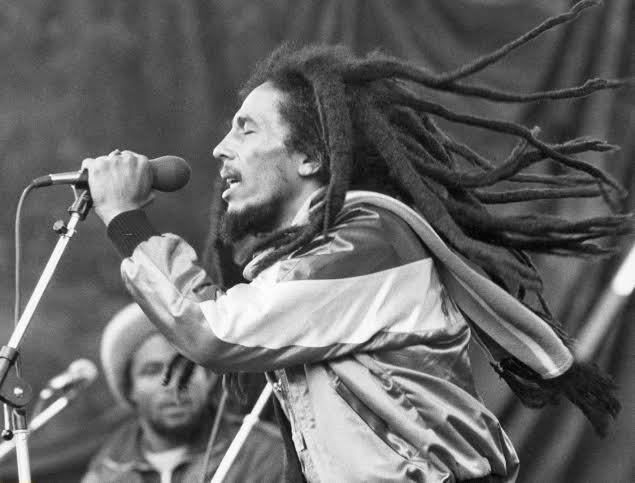
The “No Woman No Cry” here is the live version, and it remains the album’s emotional centre. It was captured at London’s Lyceum Theatre across two nights in July 1975, and Blackwell noticed how the crowd reacted to the song on the first night.
That roar of recognition, thousands of voices carrying Marley’s memories of Trench Town back to him, is why the live take became the definitive one.
Listeners who grew up with different pressings may notice the record has never been entirely fixed. Several songs appear as remixes, including “Buffalo Soldier,” “One Love,” “Waiting in Vain,” “Exodus” and “Jamming,” while others such as “Could You Be Loved,” “Stir It Up,” “I Shot the Sheriff” and “Satisfy My Soul” turn up as edits.
The remastered CD was handled by Barry Diament and Rob Fraboni, a US 180-gram vinyl reissue followed in July 2009, and a 30th-anniversary edition added never-before-heard versions of “Easy Skanking” and “Punky Reggae Party.” The 1995 set Natural Mystic: The Legend Lives On later served as a companion piece.
The Chart Run That Never Ended
In the UK, Robinson’s strategy paid off immediately. Legend went straight to No. 1 for the week of 19 May 1984 and stayed there for 12 consecutive weeks, then spent eight more in the top ten.
Its unbroken chart run lasted 74 weeks, into October 1985. It has since been certified 13 times Platinum in Britain and stands as the 16th best-selling album in UK history.
America was a slower burn, and a far longer one. Legend debuted at a modest No. 54 on the Billboard 200 in 1984. Its second life came decades later.
After Billboard changed its catalog rule in 2009, the album was allowed back onto the main chart, and in 2014 a 99 cent Google Play discount sent it surging to a new peak of No. 5 on 20 September.
That made it Marley’s highest-charting US album, topping the No. 8 peak of 1976’s Rastaman Vibration. The RIAA certified it 15 times Platinum the same year.
The longevity numbers now read like science fiction. Legend was only the second album ever to reach 800 weeks on the Billboard 200, following Pink Floyd’s The Dark Side of the Moon, and it repeated that feat at 950. As of November 2026 it has logged 963 nonconsecutive weeks on the chart.
On Billboard’s Reggae Albums chart it has spent 299 weeks at No. 1, the longest reign in that chart’s history, and in 2025 it was the top-selling reggae album in the US for the sixth straight year.
By May 2024 it had racked up 13 million pure album sales and 5 billion US streams, with worldwide sales estimated at around 25 million.
The Argument That Follows It
For all that success, Legend has never escaped its critics. Many see it as a deliberately inoffensive selection that sidelines the harder, more political Marley of records like Burnin’ and Survival.
Writing in 2014, Phoenix New Times critic David Accomazzo argued that Robinson tailored the tracklist for white audiences, saying “he constructed a greatest-hits album that showed just one face of the Marley prism.”
Even Blackwell has been ambivalent about trading Marley’s religious and revolutionary messages for mass-market picks.
It is a fair tension. Get Up Stand Up,” “Redemption Song” and “Exodus” are all here, but they arrive cushioned by love songs and sing-alongs, the fire framed for comfort.
Why Legend Still Matters
Legend is both less and more than Bob Marley’s full story. It flattens a revolutionary into a summer soundtrack, and yet it has carried his voice into more homes than any Wailers studio album ever reached.
Rolling Stone placed it at No. 46 on its 2003 list of the 500 greatest albums, and each new generation seems to discover it all over again.
For reggae and dancehall fans, the smartest way to treat Legend is as a front door. Walk through it, then keep going: into Catch a Fire, Natty Dread, Survival and the righteous anger the compilation softened.
Four decades on, the record Dave Robinson built in a boardroom still does what he hoped it would. It makes people fall in love with Bob, and that love tends to lead somewhere deeper.