
Stand near any sound system long enough and you will hear it before the next tune drops: the selector grabs the mic, the bass dips, and out comes a string of big-ups for the crew, the area, the ladies in the front.
It is one of the most generous phrases in Jamaican Patois, and one of the most travelled.
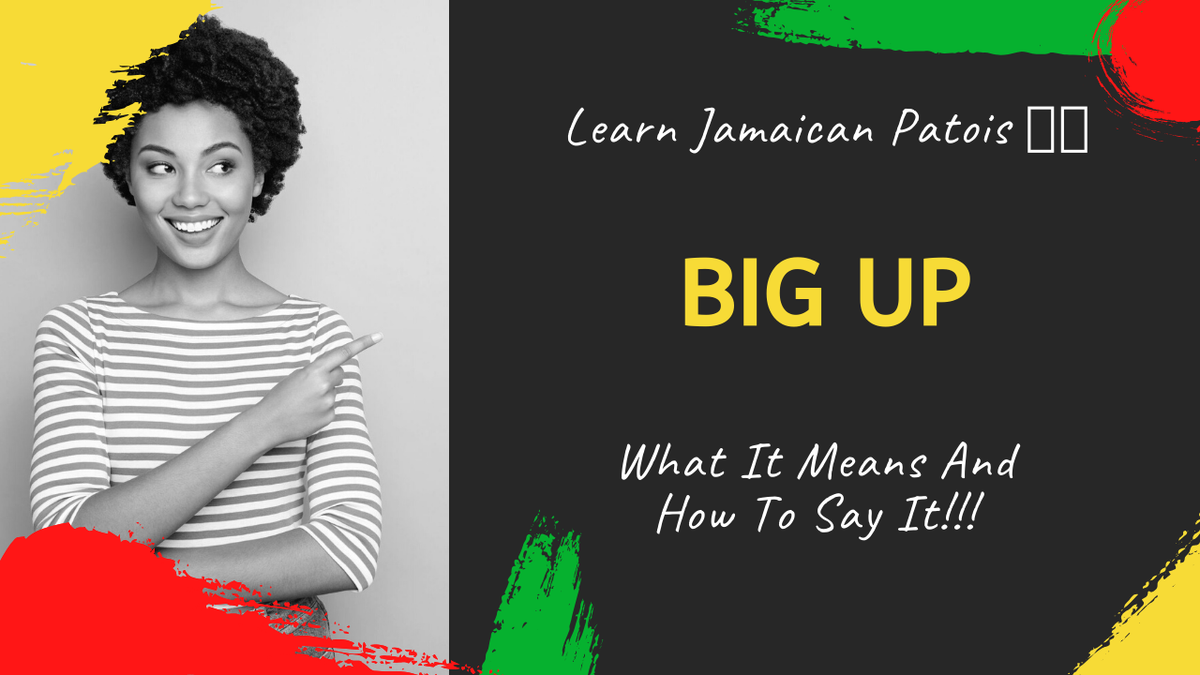
So what is the big up meaning, exactly? To “big up” someone is to give them respect, praise or a shout-out. It acknowledges a person’s achievements, their character or simply the effort they put in.
Think “well done”, “props” or “respect”, delivered with Jamaican warmth and usually at full volume.
What “Big Up” Means
At its core, “big up” is about lifting someone. One popular, if informal, explanation is that the “up” signals elevation, so to big someone up is to raise them high in the eyes of everyone listening.
The Jamaican root is plain English “big”, reworked the way Patois reworks so much of the language it inherits.
The phrase carries a few related senses. The first and most common is praise or commendation, as in “Big up Miss Lou!”, a salute to the great champion of Jamaican language and culture.
The second is a greeting, something close to “nice to see you” or “my regards.” The third shows up in commands like “big up yuhself”, which tells someone they have your respect.
Across all three the register stays the same: informal, celebratory and full of goodwill.
Where the Phrase Comes From
Nobody filed paperwork the first time a deejay bigged up the dance, but the phrase grew up inside reggae and dancehall. Among musicians it became a greeting of respect, often shouted during live performance.
Oxford University Press lexicographers single out Jamaican usage as the most significant Caribbean contribution to the term, and the classic stage version they cite says it all: “Big up all massive and crew!”
From the bandstand the phrase spread fast, carried by performers of Jamaican background, especially in Britain.
At a 1991 reggae concert in London, DJ Macka B was handing out big-ups freely, a moment captured by scholar Carolyn Cooper in her book Noises in the Blood: “I’m big-up Jamaica, big-up Rastaman.
That British connection matters. Jamaican usage shaped UK English first and US English after.
The phrase moved out of Jamaican communities in London and Birmingham into UK sound system culture, then into grime and everyday street talk.
Jamaican Patois has heavily influenced Multicultural London English, and its slang rings out in New York, Miami and Toronto too.
In New York, Caribbean immigrants helped shape early hip-hop culture, and through the 90s and 2000s “big ups” settled comfortably alongside “shout-outs” and “props.
How to Use “Big Up”
Part of the phrase’s charm is its flexibility. It works as a verb, an interjection and a noun.
This is the everyday Jamaican form. “Mi haffi big up mi madda” means “I have to acknowledge my mother.”
Or, with a little more detail: “Mi haffi big up Brian fi everything him duh fi wi”, meaning “I have to give respect to Brian for everything he has done for us.”
In English the past and continuous forms are “bigged up” and “bigging up.” The OUP author noted finding no Jamaican examples of “big-upping,” so leave that one to the UK.
Shout it on its own and it becomes a salute. “Big up all di real one dem!” translates neatly as “Shout-out to all the real ones!” This is the version you hear on a mic, in a voice note or at the end of a radio link.
Outside Jamaica the phrase often becomes a thing you give: “a big up” or “big ups.” “I want to give a big up to my bro on the mic” is classic English slang usage.
Even mainstream American media picked it up; a 2003 Sports Illustrated line declared that something “deserves big ups for its brazen chutzpah.”
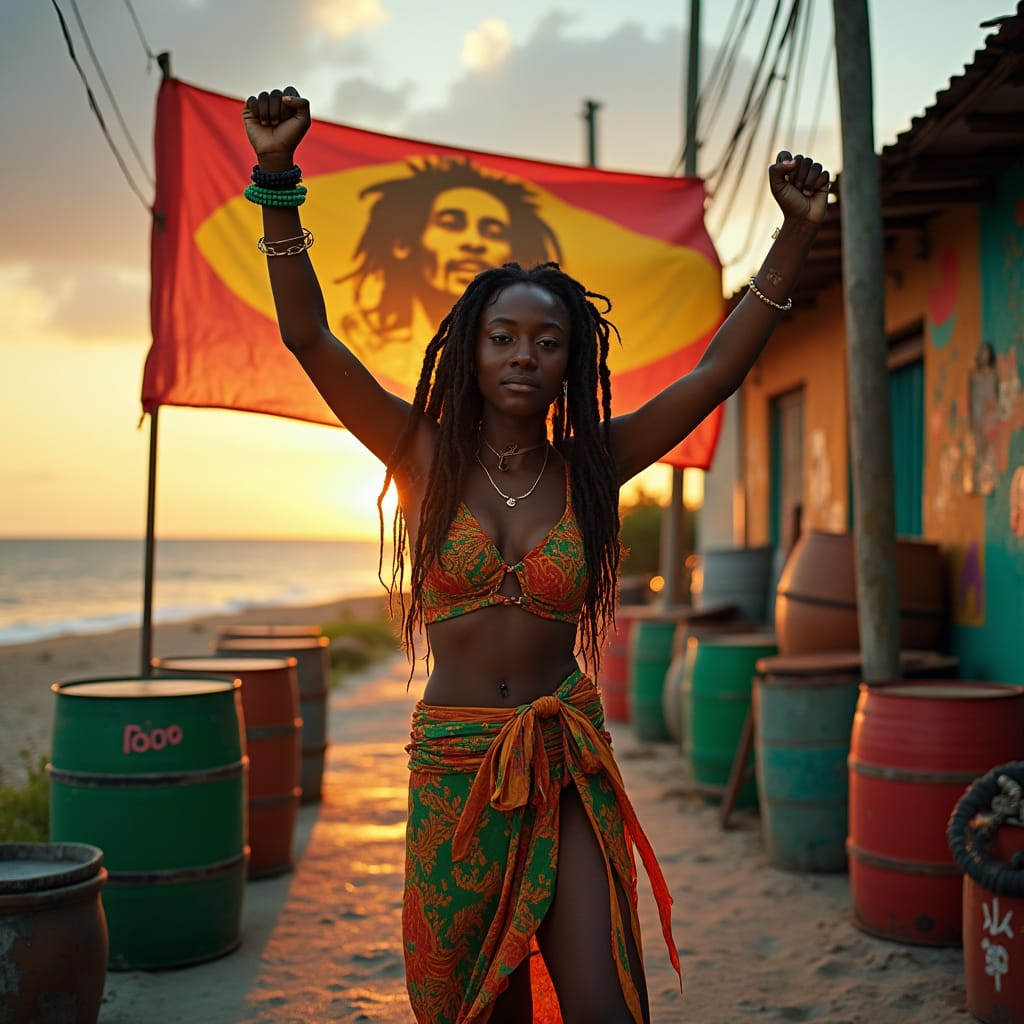
“Big up yuhself” is pure encouragement. Depending on the moment it means “respect to you,” “well done” or “stay strong.”
It can also be a pat on your own back, a reminder to give yourself credit after you have put in the work.
The phrase lives on the page as well as the stage. Jamaican yearbooks, letters and social posts are full of it, like the 2010 yearbook line “Big up wi teacha dem.”
That same year a reader’s letter to the Jamaica Observer gave a big up to the people who helped Haiti, showing how naturally the phrase carries gratitude in formal settings too.
Big Up, Respect and Bless Up
“Big up” sits in a family of Caribbean goodwill words. “Respect” is its closest cousin and often travels right beside it. “Bless up” is another relative, a warm sign-off that also shows up as a closing salutation in Vincentian Creole.
The difference is mostly about function: you big someone up to praise them, you bless up to wish them well on the way out.
Common Misreadings
Because the phrase hops between countries, its meaning can blur. Some listeners hear “Big up for ya!” in films and assume it means “good luck” or “see you later.”
In UK rap slang it sometimes stretches toward “thanks a lot.” English speakers have also bent it into “to make bigger,” literally or figuratively, or “to pay homage to.” Those uses are close cousins, but the heart of it never changes: respect and acknowledgement.
Big Up in Music and Pop Culture
The phrase has worked its way onto record sleeves too. Aswad named their 1987 album Big Up, Shaggy has a song called “Big Up”, and there is even a band called Big Ups. Its reach today is global.
Under Koffee’s video for “Toast”, published in November 2018, fans from Germany, Kenya, Scotland and Toronto left comments bigging up the young star, proof that the phrase now belongs to anyone who loves the music.
It is still being taught to new learners as well, with Patois lessons on TikTok walking viewers through exactly how to use it.
Why “Big Up” Still Matters
Plenty of slang burns bright for a summer and vanishes. “Big up” has lasted because it does something people always need: it says “I see you.”
It came off the sound system mic as a way for deejays to salute the massive, crossed the Atlantic with the Jamaican diaspora, and settled into the speech of London, New York and Toronto without ever losing its roots.
When you big someone up you are borrowing a small piece of dancehall culture, a tradition of public praise and shared celebration. So use it generously. Big up your madda, big up your crew, and once in a while, big up yuhself.