
As the United States marks its 250th year of independence, we trace how an island of fewer than three million people rewired American pop culture, one bassline at a time.
There is a strange and beautiful math at the heart of American popular music. The United States is the largest cultural exporter the world has ever known, yet for seventy years it has kept importing sound from a single Caribbean island roughly the size of Connecticut.
Mento, ska, rocksteady, roots reggae, dub, dancehall ,each Jamaican wave has washed up on American shores and left the beach permanently rearranged. Hip-hop’s sound-system DNA, EDM’s drop, pop’s love affair with the offbeat: none of it looks the same without Kingston.
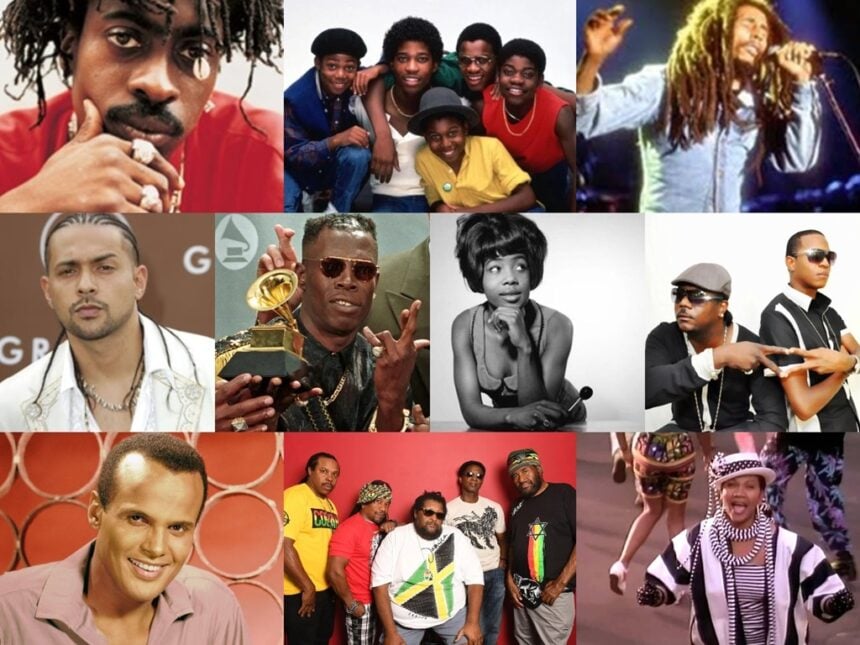
To mark America’s 250th birthday, here are 25 Jamaican records presented roughly in the order history handed them to us that didn’t just cross over into the U.S. charts, but changed what American ears expected music to feel like. Each entry includes a link to hear it for yourself.
List of Songs
Part I : Before Reggae Had a Name (1956–1972)
Day-O (The Banana Boat Song) , Harry Belafonte (1956)
Belafonte was Harlem-born, but he spent formative childhood years with his grandmother in Jamaica, and the island’s mento work songs never left him. “Day-O” the dawn cry of a dock worker begging the tally man to count his bananas so he can go home, turned that folk tradition into a global phenomenon. It anchored Calypso (1956), widely cited as the first solo LP to sell a million copies, and the single climbed to No. 5 on the U.S. charts. Belafonte, who died in 2023 at 96, used the fame that followed to become one of the era’s most important civil-rights financiers and organizers.
My Boy Lollipop, Millie Small (1964)
This is the record that put both ska and a fledgling label called Island Records on the world map. Produced by a young Chris Blackwell, Millie Small’s bubbling cover reached No. 2 in both the U.K. and the U.S. and is often credited as the first international ska hit, reportedly selling some six million copies. It made a teenager from Clarendon into Jamaica’s first global pop star and gave Blackwell the capital and confidence that would later bankroll Bob Marley.
The Harder They Come, Jimmy Cliff (1972)
Perry Henzell’s film and its soundtrack did what no single song had managed: they handed America a full, unfiltered picture of reggae and the Kingston world that made it. Cliff, playing the outlaw Ivanhoe “Ivan” Martin, sang the defiant title track, and the soundtrack became a slow-burning cult phenomenon, passed hand to hand on the West Coast and in college towns that turned reggae from a novelty into a movement. It remains one of the most influential film soundtracks ever released.
Part II: Reggae Goes Global (1973–1978)
Concrete Jungle. The Wailers (1973)
The opening track of Catch a Fire, the album that broke The Wailers internationally. Blackwell’s controversial masterstroke was to overdub American and British rock musicians onto the Kingston tapes most memorably guitarist Wayne Perkins, a Muscle Shoals session player who improvised a searing solo he cut nearly blind, having never heard reggae before. That fusion of roots rhythm and rock guitar is precisely what made the album legible to American radio.
Roots, Rock, Reggae, Bob Marley & The Wailers (1976)
Here is a fact that surprises even devoted fans: this stomper from Rastaman Vibration was the only Bob Marley single ever to reach the Billboard Hot 100 during his lifetime, peaking at No. 51 in the summer of 1976. The global superstardom we now attach to Marley was, in America, almost entirely posthumous which makes this modest chart run a genuine historical landmark.
Jammin’ , Bob Marley & The Wailers (1977)
From Exodus — an album Time magazine would later crown the best of the 20th century “Jammin'” is reggae at its most joyously communal. Its reach into the American mainstream is best measured by tribute: Stevie Wonder named and modeled his 1980 hit “Master Blaster (Jammin’)” directly on Marley’s groove, a Black-American superstar bowing to a Jamaican one.
Now That We Found Love, Third World (1978)
Third World took a Gamble & Huff song first cut by Philadelphia soul group The O’Jays and reggae-fied it into a dancefloor sensation, filling rooms as glamorous as New York’s Studio 54. The reggae-soul hybrid proved so durable that Heavy D & the Boyz turned it into a hip-hop hit all over again in 1991, a rare song to conquer American dancefloors twice, in two different genres, over two different decades.
Part III: The Crossover Eighties
Electric Boogie, Marcia Griffiths (1982 / 1989)
Written by Bunny Wailer, “Electric Boogie” became inseparable from the “Electric Slide,” the line dance choreographer Ric Silver built around it. Thanks to that pairing, the song became a permanent fixture of American weddings, cookouts, and reunions arguably the most-danced-to Jamaican record in U.S. history, and one of the best-selling singles ever by a female reggae artist.
Pass the Dutchie, Musical Youth (1982)
A group of Birmingham schoolboys of Jamaican descent reworked The Mighty Diamonds’ “Pass the Kouchie.” Because a “kutchie” is a cannabis pipe, the kids sang about a “dutchie” a cooking pot instead. The sanitized version topped the U.K. chart and cracked the U.S. Top 10, and its video became one of the first by Black performers to go into heavy rotation on the young MTV, quietly widening the channel’s definition of who belonged on it.
My Jamaican Guy, Grace Jones (1982)
Cut at Compass Point in the Bahamas with the peerless rhythm section of Sly Dunbar and Robbie Shakespeare, this slinky groove from Living My Life became a U.S. club staple. Its afterlife is pure hip-hop royalty: LL Cool J built his 1996 hit “Doin’ It” on its bones. Jones, born in Spanish Town, remains one of the most singular Jamaican exports of all, a fashion, art, and music icon in equal measure.
Close to You, Maxi Priest (1990)
British-born to Jamaican parents, Maxi Priest achieved something almost no reggae artist had: an outright No. 1 on the Billboard Hot 100. This smooth, radio-perfect single made him one of the very few reggae singers to top America’s flagship chart, proving lovers rock could sit comfortably beside R&B on Top 40 radio.
Part IV: Dancehall Conquers America (1991–1999)
Housecall, Shabba Ranks & Maxi Priest (1991)
The reigning king of dancehall met the smoothest voice in lovers rock, and the U.S. took notice. Shabba was already a trailblazer, the first dancehall artist to win a Grammy and “Housecall” pushed his gruff, commanding style into the American Top 40, opening the door that the rest of the decade’s dancehall stars would walk through.
Dolly My Baby, Super Cat (1992)
The “Wild Apache” earned a devoted hip-hop following with this cut from Don Dada and its remix is a genuine piece of rap history, featuring early guest verses from a then-unknown Notorious B.I.G. and a young Sean “Puffy” Combs. It’s one of the clearest early bridges between Kingston’s deejays and New York’s rappers, two cultures that were always closer than the map suggested.
Flex, Mad Cobra (1992)
Riding a Sly Dunbar rhythm, this seductive slow-wind became one of the biggest dancehall crossovers of its era, climbing to No. 13 on the Billboard Hot 100 in 1993. It demonstrated that an American mainstream audience would embrace dancehall’s sensual side, not just its rowdy anthems.
Bad Boys, Inner Circle (1993)
First recorded in 1987, “Bad Boys” found immortality as the theme to the long-running American reality series COPS, making its “whatcha gonna do” hook one of the most recognized pieces of Jamaican music on U.S. television. Re-released, it reached No. 8 on the Hot 100 in 1993 and helped Inner Circle win a Grammy, proof that the right sync placement could embed a reggae band in the American living room for decades.
Boombastic, Shaggy (1995)
All swagger and low-end charm, “Boombastic” announced Shaggy as a bona fide hitmaker, reaching the U.S. Top 5 and winning the Grammy for Best Reggae Album. It cemented a template playful, radio-friendly dancehall-pop that Shaggy would ride to even greater heights before the decade was out.
Who Am I (Sim Simma), Beenie Man (1997)
Built on producer Jeremy Harding’s “Playground” riddim, “Who Am I” and its instantly quotable hook (“Sim Simma, who got the keys to my Bimma?”) gave Beenie Man his American breakthrough. From the acclaimed Many Moods of Moses, it counted no less than Stevie Wonder among its admirers and set up Beenie Man’s own Grammy win a few years later.
Everyone Falls in Love, Tanto Metro & Devonte (1998)
The little song that did. Produced by Donovan Germain at the legendary Penthouse studio, this feel-good duet was a smash at home, then boosted by major-label distribution in the States crossed onto Billboard’s Hot R&B/Hip-Hop and Hot 100 charts. It endures as one of Jamaica’s most beloved singalongs and a wedding-playlist mainstay across the diaspora.
Part V: The Chart-Topping 2000s
It Wasn’t Me, Shaggy featuring RikRok (2000)
The cheater’s anthem to end all cheater’s anthems. Powered by a viral word-of-mouth surge, “It Wasn’t Me” went No. 1 in the United States and around the world, carrying its parent album Hot Shot to the top of the Billboard 200. It made Shaggy one of the best-selling reggae artists in history and remains an inescapable karaoke staple.
Gimme the Light, Sean Paul (2002)
The lead spark of Dutty Rock, “Gimme the Light” reached No. 7 on the Hot 100 and introduced America to the rapid-fire patois flow that would define the decade’s biggest dancehall crossover artist. It was the opening move in an extraordinary run, Sean Paul would soon become one of the few artists to score multiple Hot 100 No. 1s.
No Letting Go, Wayne Wonder (2003)
Wayne Wonder rode Steven “Lenky” Marsden’s revolutionary “Diwali” riddim to No. 11 on the Hot 100 and here’s the deeper story: that same riddim, with its distinctive hand-clap pattern, also powered Sean Paul’s chart-topping “Get Busy” and Lumidee’s “Never Leave You.” For one remarkable year, a single Jamaican rhythm track was the engine under multiple American hits. “No Letting Go” was later certified gold.
Welcome to Jamrock, Damian Marley (2005)
Bob’s youngest son proved the family’s power to speak to America was no accident. Sampling Ini Kamoze’s “World-A-Music” over a hard Sly & Robbie rhythm, “Welcome to Jamrock” was a gritty, unflinching portrait of Kingston that struck dancehall, hip-hop, and rock listeners alike. It swept the 2006 Grammys, winning both Best Reggae Album and Best Urban/Alternative Performance.
Temperature, Sean Paul (2006)
An aptly named record that ran hot all summer. Produced by Rohan “Snowcone” Fuller, “Temperature” gave Sean Paul another U.S. No. 1 and became one of the defining pop songs of 2006, keeping dancehall firmly in the center of the American mainstream rather than at its edges.
Part VI: A New Generation (2014–2019)
Cheerleader, OMI (2014 / 2015)
Omar “OMI” Pasley from Clarendon recorded a sweet acoustic tune that might have stayed a regional favorite until German producer Felix Jaehn’s tropical-house remix sent it around the planet. It didn’t just chart in America; it hit No. 1 on the Billboard Hot 100 in the summer of 2015 and spent weeks on top, one of the biggest songs of that year worldwide and a defining record of the “tropical house” moment.
Toast, Koffee (2019)
Proof that Jamaica’s next wave was already breaking. Produced by IzyBeats and Major Lazer’s Walshy Fire, “Toast” was a gratitude anthem that won Koffee a diverse hip-hop and R&B following. Its parent EP, Rapture, won Best Reggae Album at the 2020 Grammys making Koffee, born Mikayla Simpson, the youngest artist and the only woman ever to win in that category. The lineage that began with Belafonte reaches her, unbroken.
Seventy years separate Harry Belafonte’s banana-boat call from Koffee’s toast, and yet the story barely changes. A small island keeps sending America new ways to move, and America keeps building its own pop culture on top of them. The sound system begat the DJ; the deejay begat the rapper; the offbeat “skank” wormed its way into everything from ska-punk to reggaeton to tropical house. On a 250th birthday devoted to what the United States has built, it’s worth remembering how much of the soundtrack was written in Kingston.
Happy Independence Day, turn it up.