Stand near any sound system long enough and you will hear it: a selector shouting “fiyah pon Babylon,” a crowd answering back, a roots tune swelling underneath.
The Babylon meaning in Jamaican Patois is simple to state and deep to unpack.
Babylon is the Rastafari name for the oppressive system: corrupt government, colonial power, materialism. In everyday street talk, it is also the word for the police.
That double life is what makes the word so powerful. It can point at a uniformed officer pulling over a car on a Kingston road, or it can point at the whole machinery of Western capitalist society.
To understand Babylon is to understand how Rastafari, and the reggae that carried its message, read the world.
Babylon Meaning: The Short Definition
Babylon (pronounced BAB-i-lon) is a Rastafari term for the police or the corrupt government system. More broadly, it describes any person or organisation that oppresses the innocent.
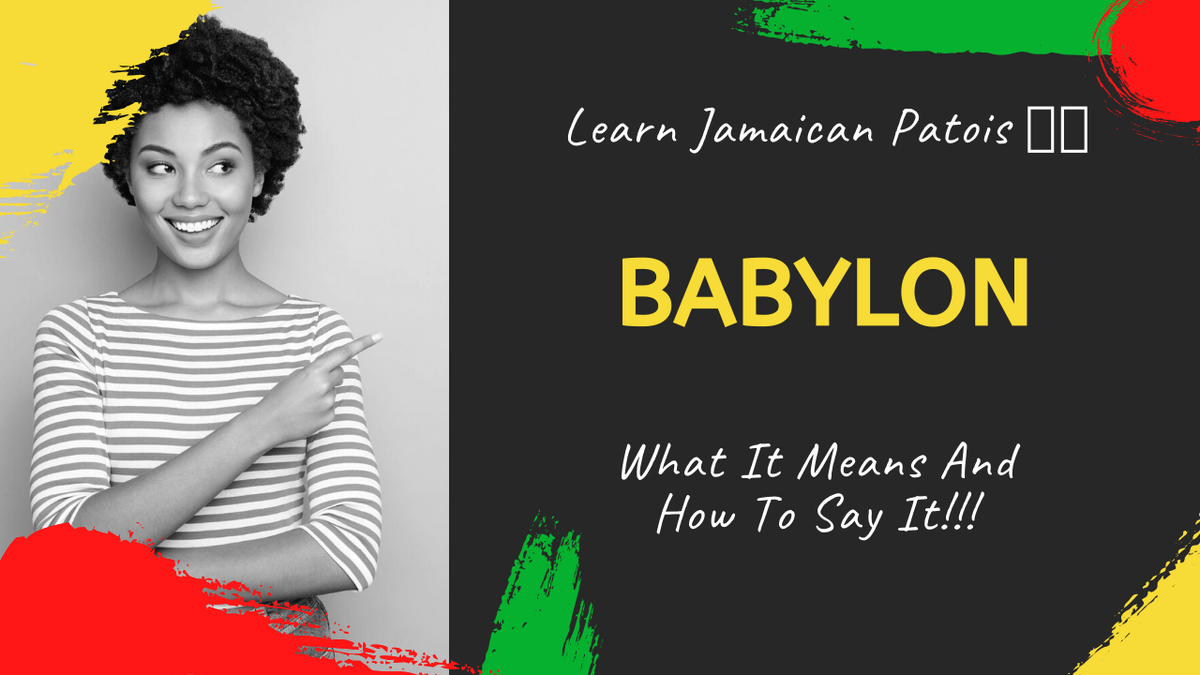
Reggae writers have long treated it as a catchall. It covers the police, governmental “politricks,” religious and financial institutions, and the justice system.
It is less a single target than a way of naming everything that keeps poor people down. A related term, “Babylon bwoy,” refers specifically to a policeman.
Where the Word Comes From
The term comes straight out of the Bible, where Babylon is the place of exile and oppression. After the Babylonian conquest of Jerusalem in 586 BC, the people of Judah were carried off into captivity.
Psalm 137 is their communal lament, sitting by the rivers of a foreign land, remembering Zion and yearning for Jerusalem.
For the Rastafari movement, which grew out of impoverished Afro-Jamaican communities in the 1930s, that story of exile hit home.
Rastafari centres on the African diaspora, which it sees as oppressed within Babylon, understood as Western capitalist society.
Many Rastas hold Babylon responsible for the Atlantic slave trade and for the poverty that still grips the diaspora. The ancient captivity became a mirror for the modern one.
Babylon as the Police
On the street, Babylon most often means the cops. The reason is rooted in history. By the 1950s, Rastafari had clashed with wider Jamaican society, including violent run-ins with law enforcement.
Police arrested Rastas for using marijuana, which they regard as sacramental, so officers came to embody the system at its most direct and physical.
That is why the word works on two levels at once. When someone says Babylon is coming, they might mean a single patrol car. They also mean everything that patrol car stands for.
Babylon and Zion
You cannot fully grasp Babylon without its opposite. In Rastafari thought, Zion is a utopian place of unity, peace and freedom, while Babylon is the oppressing and exploiting system of the materialistic modern world.
Rastafari identify themselves and Africa as Zion, with Ethiopia acknowledged as the mountains of Zion.
One Rasta explainer puts the contrast neatly: “Babylon oppresses; Zion restores.”
There is nuance here that casual listeners often miss. When Rastafari speak of Babylon, they usually do not mean every individual caught up in the system.
Someone can work inside its institutions and still live with integrity. The target is the structure, not every person within it. Bob Marley captured that idea in his own way: “Who the cap fit let them wear it.”
How to Use Babylon in Patois
Here is how the word sounds in real conversation, with English translations.
“Wah Babylon bwoy a cum.”
A policeman is coming.
“Babylon pull over di car fi check di papers.”
The police pulled over the car to check the documents.
“Babylon cyaa wul wi dung fi eva.”
The corrupt system can’t hold us down forever.
“Fiyah bun babylon kaaz dem eva deh taament poor people.”
I denounce the police because they are always tormenting poor people.
“Chant down Babylon!”
Bring down oppression.
Notice how the first two examples lean toward the police meaning, while the third reaches for the bigger system. Context does the work.
Meanings also shift from speaker to speaker. As one observer of the culture put it, “Babylon has different definitions for different people.”
Babylon in Reggae
No genre has done more to carry the word around the globe than reggae. In 1970, The Melodians turned Psalm 137 into “Rivers of Babylon,” setting the ancient lament to a Jamaican rhythm.
Three years later, Marley, Peter Tosh and Bunny Wailer delivered “Rastaman Chant,” with its prophetic line “Babylon your throne gone down.
Marley kept returning to the theme. In 1978, Bob Marley and the Wailers released Babylon by Bus, a double live album recorded on a European tour.
On Survival, an album originally titled Black Survival, he wrote “Babylon System” alone. It stands as his most detailed portrait of the system, built around one of the most quoted images in roots music: “Babylon system is the vampire … Sucking the blood of the sufferers.”
Then there is “Chant Down Babylon,” which repeats its title phrase like a mantra and frames reggae itself as a weapon, a way to chant down oppression and “the system.” That idea, music as resistance, sits at the heart of the whole tradition.
Marley was far from alone. Peter Tosh, Burning Spear, Culture and Jimmy Cliff all gave voice to Babylon in their music.
Across the Atlantic, Steel Pulse cut “Babylon Makes the Rules,” and the influence even reached punk through Bad Brains and their song “Leaving Babylon.”
Related Rasta Language
Babylon belongs to a wider world of Rasta wordplay, sometimes called word-sound. The idea is that words carry power, so they should say what they mean.
That is why “oppress” becomes “downpress,” because nobody is pressed up, and “understand” becomes “overstand.”
Some Rastas go further, rejecting everyday phrases they see as Babylonian language. Instead of “good morning,” you might hear “good rising.”
It is a small shift in speech that reflects a big shift in outlook: refusing to let the system shape even the way you greet the day.
Why the Word Still Burns
Nearly a century after Rastafari took root in Jamaica, with an estimated 700,000 to 1 million followers worldwide today, Babylon remains one of the most potent words in Caribbean culture.
It travels from Kingston yards to festival stages to Patois conversations in London, Toronto and New York.
Its staying power comes from its flexibility. Babylon can be a policeman at a roadblock or the entire weight of history pressing down on the poor. It names exile, resistance and the hope of a way home to Zion.
Every time a crowd roars back at a selector calling for fire on Babylon, that old biblical story finds new life on the dancefloor. That is the true Babylon meaning: not just a word, but a stance.