

Picking the best Bob Marley songs is like choosing a favourite room in the house you grew up in. Every corner holds something: the Trench Town yard, the Lyceum stage, the Hope Road windowsill, the long London exile. Marley’s music never really left the conversation.
On the Billboard 200 dated 26 September 2026, Legend logged its 957th week on the chart. It is only the second album ever to pass 900 weeks, after Pink Floyd’s The Dark Side of the Moon.
What follows are the twelve songs that matter most, ranked from the very top. The list takes in the rebel anthems, the love songs, the hymns and the dancefloor fillers. Some were hit singles.
Others were album cuts that grew into standards over decades. Every one of them still sounds like it was cut this morning.
1. Bob Marley & The Wailers, “No Woman, No Cry” (1975)
There is a studio version on 1974’s Natty Dread, recorded at Harry J Studio in Kingston, and it is lovely. The version the world carries in its chest, though, was captured at London’s Lyceum in July 1975.
Chris Blackwell heard the audience on the first night and brought in the Rolling Stones Mobile Studio for the second.
That recording, released as a single from Live!, is the song: the organ swells, the crowd sings every line back, and Bob comforts a woman in a Trenchtown government yard, promising her that everything will be all right.
The writing credit went to Vincent “Tata” Ford. The debate over that credit has never settled. One reading says Marley wrote the song himself and credited Ford to sidestep contractual obligations. Another says the credit was meant to help fund Ford’s work in Trenchtown.
2. Bob Marley, “Redemption Song” (1980)
Every Marley record before it was a band record. This one is just a man and an acoustic guitar. The Wailers did cut a full-band version first, but Blackwell nudged Marley toward a solo take, and that bare performance closed Uprising. The band arrangement later surfaced as a B-side in the UK and France.
The central lines draw on Marcus Garvey’s speech “The Work That Has Been Done.” Marley was already reciting those words at the Amandla Festival in July 1979.
The song came out as a single on 7 October 1980, only months before his death, and it now reads like a last testament.
Rolling Stone placed it at No. 66 on its 2004 list of the 500 Greatest Songs. In 2020, for his 75th birthday, it got an animated video built from 2,747 drawings.
3. Bob Marley & The Wailers, “Get Up, Stand Up” (1973)
Some songs ask politely. This one plants its feet. Marley wrote it with Peter Tosh, and his then-girlfriend Esther Anderson recalled that he was moved to write it by the poverty he saw while touring Haiti.
The track landed on Burnin’ and was released as a single on 14 September 1973. Its call and response is so simple a child could sing it, and that simplicity is the point: it was built to be chanted by crowds.
Rolling Stone ranked it No. 1 among Marley’s 50 greatest songs, and Alexis Petridis put it second in The Guardian.
The 1973 Island recording entered the Grammy Hall of Fame in 1999, the same year Funkstar Deluxe sampled it for the dance floor. Burnin’ itself joined the Library of Congress National Recording Registry in 2007.
4. Bob Marley & The Wailers, “Exodus” (1977)
Marley came to London after the December 1976 attempt on his life in Kingston, and “Exodus” is the sound of a man refusing to be broken. It is a long, rolling march of a song.
AV Club put its groove perfectly, saying it suggests dub “without quite venturing out into space” and hints at disco without a heavy backbeat.
The horns punch, the I Threes answer, and the movement of Jah people becomes something you can dance to for seven minutes.
The single reached No. 14 in the UK. It was also Marley’s first single to get widespread airplay on US black radio, a real breakthrough.
The parent album peaked at No. 20 on the Billboard 200, and in 1999 Time named Exodus the best album of the 20th century.
5. Bob Marley & The Wailers, “Could You Be Loved” (1980)
Written on an aeroplane in 1979, “Could You Be Loved” is where Marley met the disco era head on, and he won.
The scratchy guitar, the cowbell skank and that taut bassline turned it into a reggae and disco fusion that still fills any floor from Kingston to Lagos.
Released as a single on 16 May 1980, it hides a nod to the very beginning of his career: midway through, Marley quotes a verse from “Judge Not,” his first single.
Fans have never stopped choosing it. It sits in the top three of Ranker’s public vote alongside “Get Up, Stand Up” and “No Woman, No Cry.” Joe Cocker covered it in 1997. In March 2024 the biopic sent it back onto the UK Singles chart, where it peaked at No. 47.
6. Bob Marley & The Wailers, “Three Little Birds” (1977)
No Marley song has comforted more people on more bad days. “Three Little Birds” was recorded for Exodus in 1977 but waited until 1980 for its single release, when it reached No. 17 in the UK and No. 3 in Spain. The arrangement is feather light, almost a lullaby, with the I Threes floating over a lazy one drop.
Who the birds actually are depends on who you ask. Marley’s account points to the canaries that gathered on the windowsill at Hope Road. The I Threes have long said the song is about them.
Marcia Griffiths remembers Bob greeting them with, “What is my Three Little Birds saying?” Both stories have their believers, and the song is generous enough to hold both.
7. Bob Marley & The Wailers, “One Love / People Get Ready” (1977)
This one has lived three lives. It began as a ska single in 1965, a brisk Studio One era number that also appeared on The Wailing Wailers that year.
In 1977 Marley reworked it for Exodus at a slower, warmer tempo and folded in a nod to Curtis Mayfield’s “People Get Ready.” That turned a youthful rocksteady era tune into a hymn of unity.
Its third life came after his death. Island released it as a single on 16 April 1984, a posthumous release that fed into the launch of Legend and helped shape how the world would remember him.
The song’s message also gave the 2024 biopic its title, and the track sits proudly on its soundtrack. Few Marley songs have travelled so far from where they started.
8. Bob Marley & The Wailers, “Buffalo Soldier” (1983)
Recorded in Miami toward the end of the 1978 Kaya tour and co-written with King Sporty, “Buffalo Soldier” sat in the vaults until Confrontation appeared in 1983. Its subject is the black cavalry regiments who fought in the Indian Wars after 1866.
Marley reframes them as soldiers “stolen from Africa,” turning a footnote of American history into a symbol of black resistance and survival.
Wrapped in that history is one of his catchiest melodies. The “woy yoy yoy” bridge has drawn comparisons to the Banana Splits’ 1968 “Tra-La-La Song,” though no litigation ever followed.
The song reached No. 4 in the UK, the highest-placed single of Marley’s career outside Jamaica, which makes it a remarkable posthumous triumph.
9. Bob Marley & The Wailers, “I Shot the Sheriff” (1973)
Marley described it as a song about police brutality in Jamaica’s ghettos. He sings it as a confession and a defiance at once: he admits to shooting the sheriff and swears he did not kill the deputy.
On Burnin’ it moves with a slow, coiled menace. By one account it was the last single Marley released with Peter Tosh and Bunny Wailer before they went solo.
Guitarist George Terry played the album for Eric Clapton and urged him to cut the song. Clapton’s version topped the Hot 100 on 14 September 1974, the only time a Marley composition reached that chart.
Clapton later admitted he spoke to Marley about it and “tried to ask him what the song was all about, but couldn’t understand much of his reply.”
10. Bob Marley & The Wailers, “Is This Love” (1978)
Kaya was recorded alongside Exodus. When it arrived, some critics accused the band of going soft, as if the rebel had traded his fire for a spliff and a hammock. “Is This Love” is the best answer to that charge.
It is unashamedly tender, with a gently rocking organ, a bassline that sways rather than marches, and Marley singing about sharing a single bed and a roof over two heads like a man who has earned his peace.
Released as a single on 3 February 1978, it became a top-ten hit in the UK. It anchors side one of Legend, and it appears on the 2024 biopic soundtrack. Decades on, it has become the Marley song couples choose for their first dance.
11. Bob Marley & The Wailers, “Jamming” (1977)
Here is Marley at his most buoyant. “Jamming” came out as a single on 3 June 1977, backed with “Punky Reggae Party,” his salute to the London punks who had embraced reggae.
The A-side is pure lift: a bubbling keyboard, a bright guitar chop, and a chorus that turns a night of music into a spiritual act.
AV Club argued that the song “sanded away rougher edges” to create a bounce that became the foundation of the Sunsplash reggae that swept across North America. That is a fair reading.
You can hear the blueprint for a generation of festival reggae in its easy groove. Its reach keeps growing: Farruko reworked it as “Rasta Reggae (Jamming)” on the biopic’s inspired-by EP.
12. Bob Marley & The Wailers, “Stir It Up” (1973)
Long before the world knew his name, it knew this song. Marley first recorded “Stir It Up” in 1967, but it only became a proper hit when Johnny Nash covered it in 1972.
That made it the first Marley-written song to succeed outside Jamaica. A year later the Wailers reclaimed it on Catch a Fire with a slinky, sensual reading full of space and slow-burning guitar.
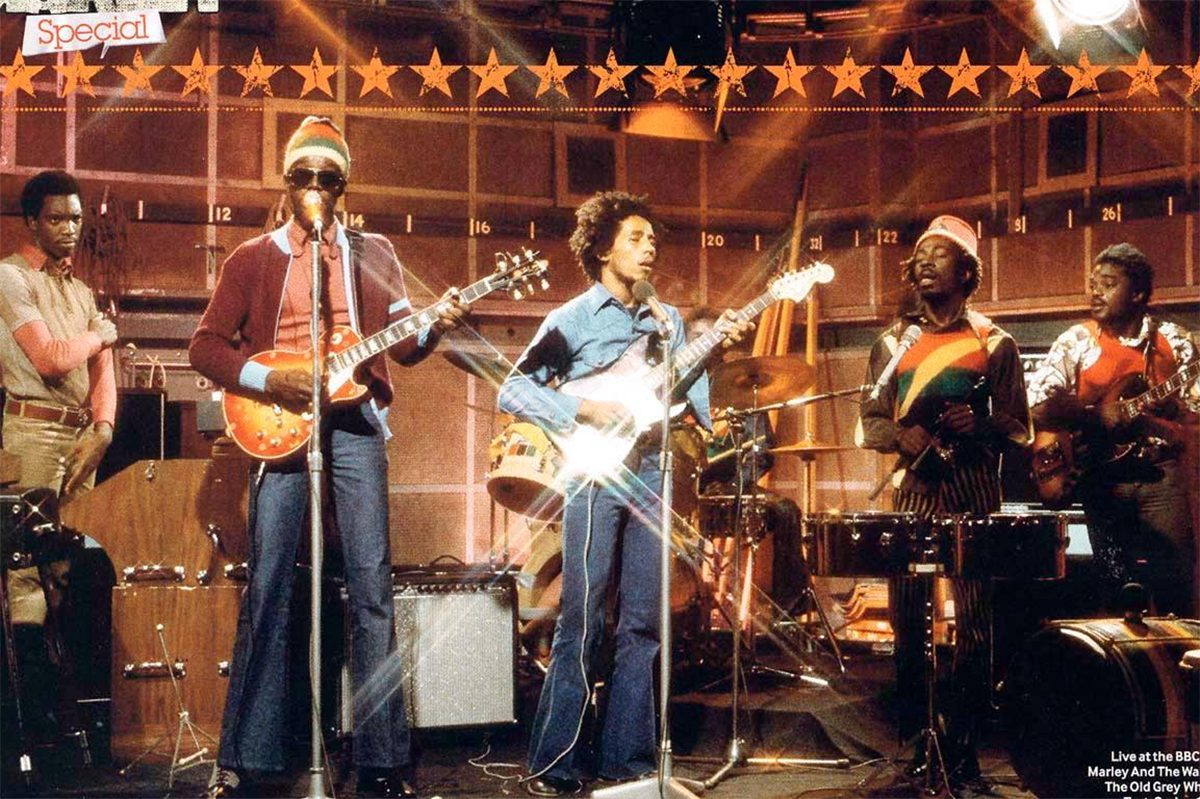
When they performed it on The Old Grey Whistle Test in 1973, they sang live over a backing track that Blackwell had overdubbed.
British television audiences got their first real look at the Wailers through that performance. Gold Radio ranked it as Marley’s greatest song outright. Even at the bottom of this list, it could top plenty of others.
Why Marley Still Rules the Rotation
Legend was born after Marley’s death in 1981, at a time when his face was everywhere but his records were not selling on the scale of his fame. That gap has long since closed.
The RIAA has certified the album for 18 million copies, and Forbes reported in February 2026 that worldwide sales had passed 43 million. In 2025 it was the top-selling reggae album in America for the sixth year running.
Numbers only tell part of the story, though. These twelve songs have outlived the man, the era and every format change since vinyl.
Every new generation finds its way to them, whether through a biopic, a cover or a parent’s record collection. In a yard, at a festival or on a phone at midnight, the message lands the same way it did in 1975.