


“World a Music” is one of the foundational recordings in early dancehall and roots reggae, a song whose meaning runs deeper than its hypnotic groove suggests.
Released in 1983 by Jamaican vocalist Ini Kamoze, it declares reggae music itself to be a life-sustaining force, capable of dissolving street-level tension and creating space for dignity in the dance.
The song’s full title, “World a Music (Out in the Streets They Call It Merther),” contains the central riddle of its lyrical world: how can something called “murder” be a celebration?
Who Is Ini Kamoze?
Ini Kamoze, born Cecil Campbell on 9 October 1957, is a Jamaican reggae singer who began his career in the early 1980s.
His stage name means “mountain of the true God.” He is one of the few raggamuffin performers to have been successful both in roots reggae and the modern dancehall style.

Cecil Campbell made his recording debut in 1980/81 with three singles on the Mogho Naba label. About two years later he began to work with Sly and Robbie, who started recording tunes with him at the famed Channel One Recording Studio, located at 29 Maxfield Avenue in the heart of west Kingston.
That partnership produced some of the most revered rhythm tracks of the era, and “World a Music” was the first major fruit of it.
Recording History and Release
In 1983, Sly and Robbie put out the 7-inch singles “World A Music” and “Trouble You A Trouble Me” on their own Taxi label.
The rhythms and vocals were originally laid at Channel One in Jamaica, with Solgie at the board and producers Sly and Robbie on the drums and bass, assisted by guitarist Willie Lindo with Robbie Lyn on the keys.
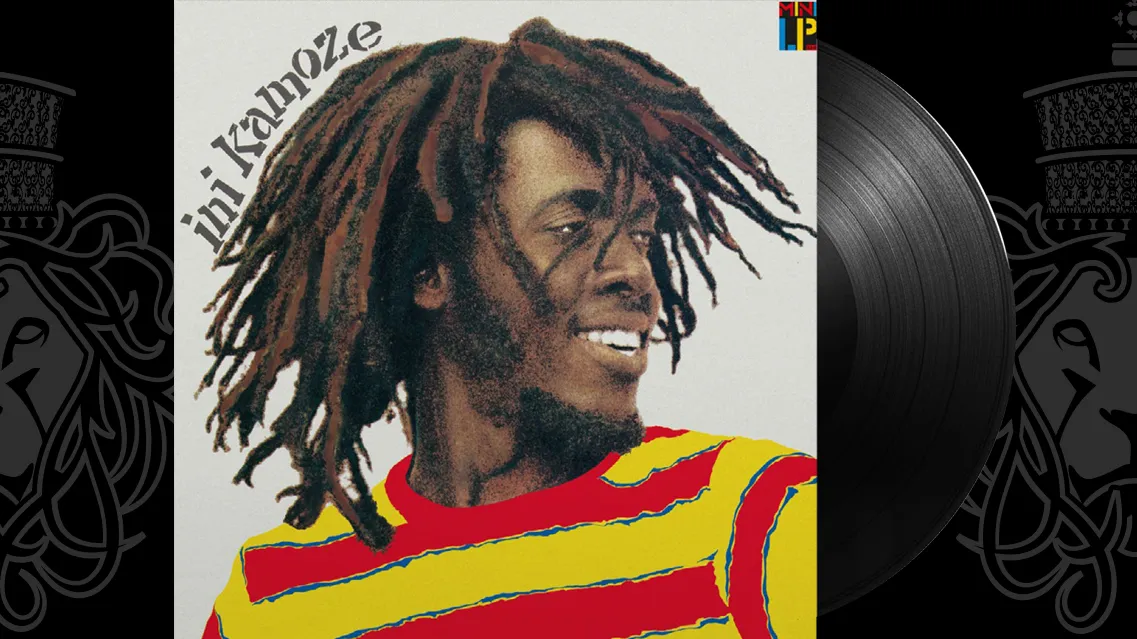
Kamoze’s self-titled debut album came out in 1984 as a six-track mini-LP on Island Records. After he had been signed to Island Records, Sly and Robbie produced Ini Kamoze’s first three albums: “Ini Kamoze” (1984), “Statement” (1984) and “Pirate” (1986).
“World a Music” was included on that 1984 debut, transferring the 1983 single to a wider international audience via Island’s distribution network.
The astounding debut album, with six vocal cuts followed by their dub versions, was Sly and Robbie’s best shot in reply to the then dominant Roots Radics sound.
The song later received wider circulation when the 1995 album Here Comes the Hotstepper, produced by Sly Dunbar and Robbie Shakespeare, included a re-recording of “World-A-Music” alongside other tracks that had appeared on Kamoze’s first three albums.
What Does “World a Music” Mean? The Core Message
The title itself operates in Jamaican Patois. “A” in Patois functions as a linking verb, so “World a Music” translates directly as “The world is music” or “The world is reggae music.”
The song positions reggae not as entertainment but as a universal condition, something already present in the fabric of daily life.
The lyrics announce this declaration in the chorus, which repeats the phrase “World a reggae music on yah” (“World of reggae music on here”), then anchors it to immediate, human experience: keeping the singer rocking, quenching a thirst, sustaining the community of the dance.
The verses carry a social message rooted in the reality of Kingston street life. The line “Now just be nice and hold your space / I won’t entertain no more disgrace” is a code of conduct: the dance is a zone of respect where antisocial behaviour is refused. Out in the streets, it is understood that disgrace will not be entertained. It is niceness that rules in the dance.
The rhythm penetrates the dancers’ consciousness and enables them to claim and hold a space in a society that often marginalises them.
The word “space” in that verse carries double weight. There are two meanings of “space” in that verse. First, it is a noun indicating physical location. It is also a verb enacting expansion of the mind, affirming a psychological place of freedom.
The second verse moves inward, with Kamoze singing about showing how a man is feeling, singing with goodness, and “ten thousand rhythms peeling / It makes the spider kiss the fly.”
The imagery is of music as an irresistible, almost supernatural force that collapses natural antagonisms. The spider and the fly, predator and prey, are brought together by the power of rhythm.
The full title of the song is “World a Music (Out in the Streets They Call It Merther),” and that word, “merther,” is the key to understanding the song’s deeper intention.
The Jamaican transformation of “murder” to “merther” evokes the symbolic meaning of the word. Ini Kamoze is not celebrating literal murder. “Out in the street they call it merther” is the paradoxical refrain of a song about manifesting positive vibrations in the dance.
In Jamaican dancehall culture, “murder” and its variants have long been used as hyperbolic praise terms.
A tune so devastating, so irresistible on the dance floor, is said to be “killing” the crowd. Kamoze’s use of “merther,” a Patois phonetic distortion, signals that the word is operating in that metaphorical register, not a literal one.
Ini Kamoze has been cited as mentioning that his “merther” referred to “musical murders” and not actual killings.
This linguistic manoeuvre, naming music as a kind of street-level devastation, aligns “World a Music” with a long tradition in Jamaican sound-system culture where the most powerful songs are described as weapons. The riddim does not wound bodies; it overwhelms them with feeling.
The Riddim: What Sly and Robbie Built
The foundation of the song is the World a Music Riddim, created by Sly Dunbar and Robbie Shakespeare at Channel One.
The track was recorded at Channel One Studio in Kingston, Jamaica, and gave its name to the legendary riddim known as the World a Music Riddim, released by Sly and Robbie through their Taxi Records label. The bass line is based on a song by Zap Pow titled “This Is Reggae Music” (1973).
The groove is anchored by Robbie Shakespeare’s bass, Sly Dunbar’s drums, and the Channel One live-room sound that gave Jamaican reggae much of its early-1980s character.
The riddim’s combination of deep, rooting bass movement and crisp, military-precise percussion created a track that collectors and selectors have prized for decades.
Legacy: Sampled Across Genres
“World a Music” achieved its widest international reach through sampling. Both the rhythm, known as “World Jam,” and the hook were sampled from the 1984 track by Ini Kamoze for Damian Marley’s “Welcome to Jamrock,” with the original rhythm having been provided by Sly and Robbie. It was released in March 2005 as the lead single from Marley’s album of the same name.
The lyrics to “Welcome to Jamrock” were performed over a riddim produced by Sly and Robbie for Ini Kamoze some 20 years earlier, and centered around poverty, politics and crime in Jamaica.
Damian Marley won the Grammy Award for Best Urban/Alternative Performance at the 48th Grammy Awards in 2006 for “Welcome to Jamrock.
Both the riddim and the hook of Damian Marley’s 2005 hit were sampled from Kamoze’s track, giving Kamoze co-writing credits.
The opening line, “Out in the streets, they call it merther,” has been sampled in countless drum and bass and dubstep tracks.
This cross-genre reach, from roots reggae into dancehall, drum and bass, and dubstep, demonstrates how deeply the riddim’s architecture penetrated global sound-system culture.
Ini Kamoze’s Broader Career
Understanding “World a Music” in context requires knowing where Kamoze went after it. The debut album was well received internationally, but Kamoze began to lose cachet among his local fans, who were increasingly turning to the popular, feel-good, DJ-driven dancehall style instead of the more traditional, message-heavy music he favoured.
By 1988, Ini Kamoze had effectively disappeared from the music scene following lukewarm reactions to his intermittent releases.
In 1994, Kamoze burst back onto the scene with a harder sound and the song which would become his signature: “Here Comes the Hotstepper.”
The single topped the US Billboard Hot 100 as well as charts in Denmark and New Zealand, reaching No. 4 on the UK Singles Chart.
The commercial peak of 1994 to 1995 eventually brought “World a Music” back to a new generation of listeners via the Here Comes the Hotstepper album re-recording, and Damian Marley’s 2005 sample ensured that Kamoze’s original vocal remained part of living dancehall culture.
Why “World a Music” Endures
“World a Music” endures because its argument is simple and undefeated: music is not a distraction from the hardships of street life, it is the most powerful force within it. The Patois title refuses the standard English hierarchy that places art above everyday reality.
In Kamoze’s framing, the world and the music are the same thing, and the dance floor is where that truth is most fully experienced. The word “merther,” at once violent and celebratory, captures that paradox in a single syllable.
Across its many lives, as a 1983 Taxi Records single, a 1984 Island Records album track, a 1995 re-recording, a 2005 Damian Marley sample, and a repeated reference point in drum and bass, the song has never had to update its message. The world is still music. The riddim still spaces out your head.