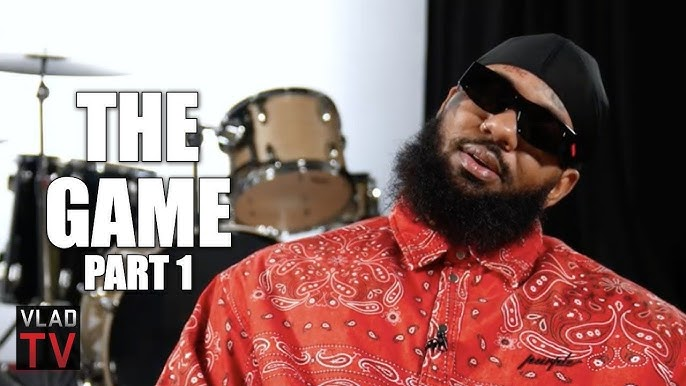

The Game has never been short on candor, but a recent sit-down produced one of the most complete accounts the Compton rapper has ever given of the life that shaped him, from a childhood spent walking through gang territory to a near-fatal shooting that left him in a coma for three weeks.
Born and raised in Compton to two parents who were Crips, the rapper described an upbringing where violence was simply background noise.
“I can remember being 7 years old, walking like 2 miles to school,” he said, recalling how he held his five-year-old sister’s hand through gang-controlled neighborhoods every morning.
Gunshots, crack pipes and bodies in the street were ordinary sights. “You didn’t really process it because it was just everyday life,” he said.
When domestic issues brought social workers to the family home, he and his siblings were removed in the third or fourth grade and placed in foster care.
He bounced through several homes before landing with a woman the children called Auntie Esther, near Carson, California.
She treated every child in her care with genuine warmth, he said, and even adopted some of them. The foster home brought an unexpected kind of brotherhood, with white and Latino kids becoming family.
“At home they was my brother,” he said. Of the six children who lived there together, he believes only three are still alive.
The wall he built during those years never fully came down. “I had to stop basically giving a f*** to cope,” he said, describing how, after about six months, he stopped waiting for his mother to walk through the door. He compared it to a first-time prisoner who cries for a week before accepting the reality of his situation.
He returned home around his freshman or sophomore year of high school, enrolled at Compton High and was one of only a handful of Bloods in a school that was overwhelmingly Crip territory.
Basketball kept him grounded, but gang life ran parallel to everything else. He went to county jail twice as a teenager, once for stealing a car in eleventh grade, and described navigating the gang module at the Twin Towers with the same strategic thinking he applied to the streets. “I was known as like the intelligent gangster,” he said.
By 2001, that strategic instinct failed him once. He was alone in a trap house, playing Madden past midnight, when a familiar face knocked at the door. Two men he had never seen came in behind the regular customer with guns drawn.
A struggle over a weapon on the kitchen table ended with him shot in the chest, the ankle and the stomach.
He crawled to the bathroom floor, called 911 from a Motorola flip phone and passed out. He did not wake up for roughly three weeks.
He said he felt no fear lying there, certain he was about to die. “I told myself, like literally told myself, I was like, damn, so this is it,” he recalled.
He had no children, his relationships with both parents were strained, and the life he had been living had conditioned him not to flinch. “I didn’t give a f*** if I died that night,” he said plainly.
The recovery period pointed him toward music. He had been watching rap videos in the trap house and dabbling with writing, and when he came out of the coma something had shifted.
He began working with producer JT the Bigger Figure, put together a demo, and eventually caught the attention of Dr. Dre through an emissary named Mike Lynn, who showed up on Cedar Block, a dead-end street the crew had locked down tight.
A visit to Encore Studios in Burbank followed, where he walked into sessions involving 50 Cent, Busta Rhymes, Eve, Nate Dogg and Snoop Dogg. He signed to Aftermath and Interscope shortly after.
“To be signed to Dr. Dre at that time was pretty huge,” he said. “But I also felt like I deserved to be.”