

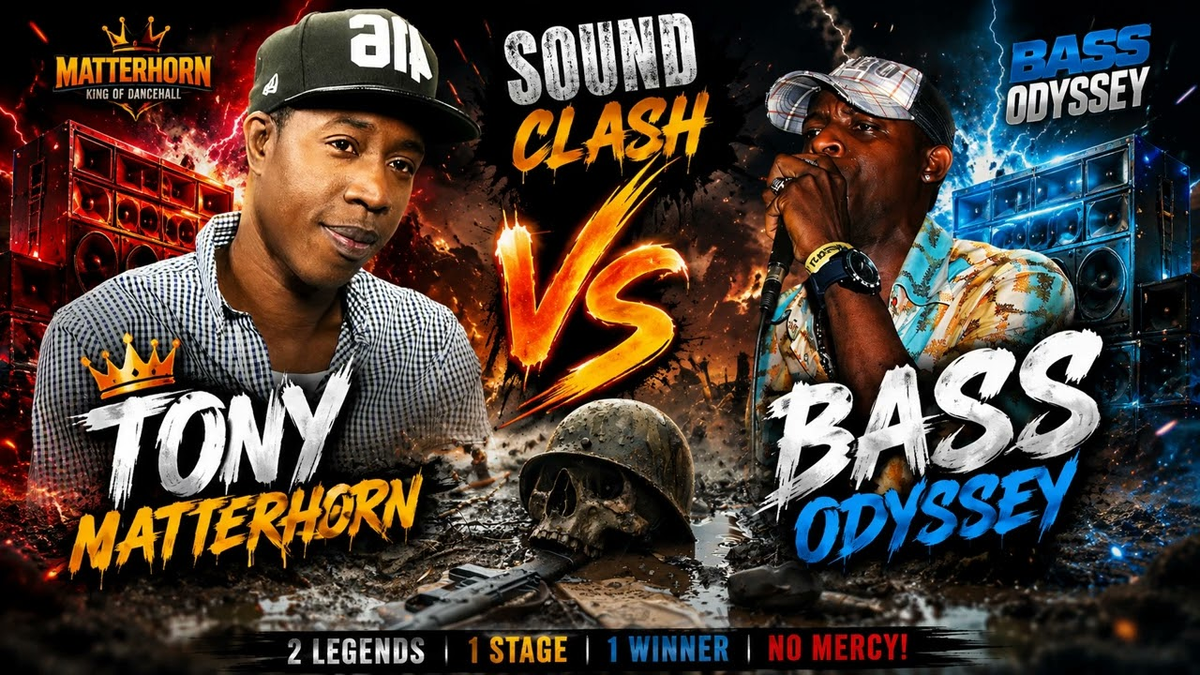
Ask any clash head to name the rivalry that never truly got settled, and Bass Odyssey vs Tony Matterhorn comes up fast.
For the better part of two decades, the St Ann institution and the Kingston-born selector kept meeting on the same stages: Boston, Toronto, Brooklyn, Queens, Montego Bay, London. Yet they almost never met alone.
Their story lives in crowded line-ups, fan tapes and arguments that still flare up whenever an old cassette resurfaces.
So who came out on top? One night stands above the rest. In April 2002, at Death Before Dishonour Part II at Pier One in Montego Bay, Matterhorn arrived as the outsider and left as champion.
The reigning kings were busy fighting somebody else. Here is how the rivalry unfolded, and why that upset still echoes.
The Two Sides
Bass Odyssey grew out of Alexandria, St Ann, where Keith Walford started out spinning at private fetes before launching the sound officially in 1989 with partner Bunny Hayles and selector Tinna-One.
Glamma G came in later, and so did Kevin “Squingy” Bennett, who joined at just 17 and went on to call himself “the Michael Jordan of clash.”
In those early days, Walford said, “it was a matter of making a name,” and you made a name by burying the sounds around you.
Tony Matterhorn, born Dufton Lafton Taylor in Kingston on 13 March 1972, came up through Inner City before linking with King Addies in Brooklyn alongside selector Babyface.
He left Addies in 1998 to build his own sound, carrying a reputation for sharp tongue work and ruthless timing.
The Timeline
1994 to 1996: The King Addies Years
The first chapter belongs to the Addies era. On 12 November 1994 in Boston, Babyface and a young Matterhorn faced Bass Odyssey with Squingy on the mic.
On 16 March 1996 the two crews met again in Toronto, this time with Lenny and Squingy holding it down for Odyssey.
These were the battles that built the feud, two hungry crews testing each other far from Jamaica in the diaspora dances where clash culture was booming.
Matterhorn’s own camp has long claimed that he and Babyface “killed” Bass Odyssey in that period. Odyssey supporters, naturally, remember it differently.
1999 to 2000: New York Gets Crowded
By the end of the decade Matterhorn was running his own sound, and New York had become the centre of the clash world.
At World Clash 1999 at The Warehouse in Brooklyn, Bass Odyssey never showed. Mighty Crown from Japan took the title over Killamanjaro and Matterhorn.

In 2000 the paths crossed repeatedly: a three-way in Florida with Fire Links, a “Fight For New York” date at Club Warehouse in Brooklyn, and World Clash on 6 October 2000 at Club Amazura in Queens.
There, Odyssey and Matterhorn shared a stacked bill with Mighty Crown, Pow Pow Movement, Little Rock and Killamanjaro, and Killamanjaro walked away with it.
April 2001: Odyssey Takes Jamaica
Then Bass Odyssey hit its stride. They won World Clash in 2001, a year Matterhorn was not on the bill.
That April, the first Death Before Dishonour in Trelawny put them against Mighty Crown, David Rodigan and Matterhorn, and Odyssey were crowned 2001 Jamaica World Champion.
Mighty Crown’s fans protested that a multi-sound affair proved nothing, which set up a one-on-one “Face Off 2K2” in Brooklyn between Odyssey and Crown. That grudge would shape everything that happened next.
April 2002: The Upset at Pier One
Death Before Dishonour Part II brought the same four names to Pier One in Montego Bay: Bass Odyssey for Jamaica, Matterhorn for the USA, Mighty Crown for Japan and Rodigan for the UK.
On paper it looked like a sequel to the Odyssey and Crown war. Odyssey were defending champions, Crown wanted revenge, and Matterhorn had stepped back from the clash scene and was trying to win his ground back.
That is exactly what made the night so dangerous. While Odyssey and Crown locked horns, Matterhorn stalked the gap between them.
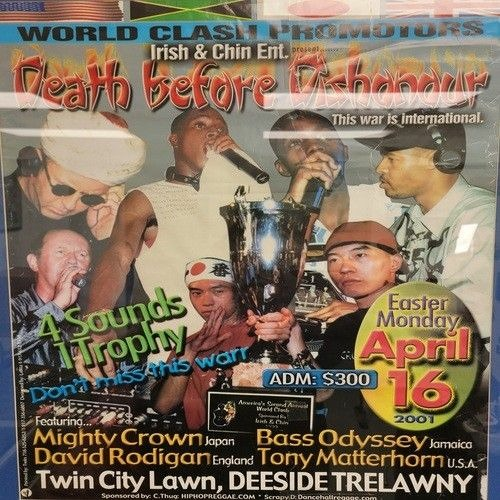
One tape dealer’s account describes the two favourites with their “backs turned” on each other while Matterhorn “changed the course of the clash.”
When it was over, Matterhorn was champion, and the result drew argument from the moment it was announced.
It was the classic clash upset: the sound nobody was watching, punishing the giants for watching only each other.
Within weeks, on 4 May 2002, he was billed at Bombrush 2k2 in New Jersey as the DB4D 2002 champion against Killamanjaro.
2002 to 2003: Back in the Pack
The crown did not settle the feud. At World Clash on 12 October 2002 in Queens, Odyssey and Matterhorn were two of seven sounds alongside Sound Trooper, Rebel Tone, King Agony, Matsimela and Red Spider, and Rebel Tone took the trophy.
On 21 April 2003, DB4D 3 at Pier One crammed six sounds onto one stage: Bass Odyssey, Mighty Crown, Killamanjaro, Rebel Tone, Matterhorn and Madd Squad. The one-on-one decider fans craved kept slipping away.
2006 to 2010: Host, Rival, Survivor
Odyssey’s dominance in the mid 2000s was hard to argue with. They won the UK Cup Clash in 2006, 2007 and 2008.
At the 2007 edition, held on 14 April at Stratford Rex in London, Matterhorn was the host rather than a competitor, watching Odyssey beat Mighty Crown 6-0 in the final round.
A year later, “The Final Conflict” put Sentinel, Bass Odyssey and Matterhorn back on the same UK Cup bill.
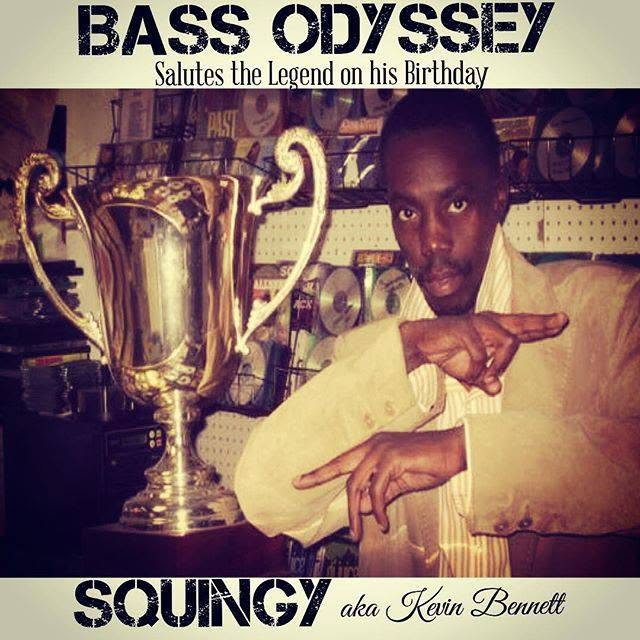
Then came loss. Squingy died on 24 November 2009, taking with him one of the most theatrical presences clash ever had.
He was famous for scaling stage rigging and talking from the speaker boxes, and DB4D promoter Garfield “Chin” Bourne never forgot it: “My most exciting moment was the year that Squingy of Bass Odyssey climbed the stage fixtures and MC’d from more than 30 feet in the air.
In 2010, DB4D announced “The Final Warr” for Easter Monday, with Odyssey, Mighty Crown and Matterhorn among the sounds. Organisers noted that only five sounds had won in the event’s nine years.
Around December that year, Matterhorn and Odyssey met once more on “Sound Clash at Sea” with Renaissance and Heavy Hammer.
Why It Still Matters
Bass Odyssey kept winning after Squingy, with titles including Guinness Sounds of Greatness in Jamaica in 2010, Sound Fi Dead in New York in 2011, War Territory 4 in Italy in 2012 and another UK Cup in 2014. DB4D itself was renamed World Clash RESET in 2012.
Walford never softened. In 2017 he turned down corporate sponsorship to protect the culture, insisting, “A sound clash has to be hard core.”
That is the real legacy of this rivalry. It never produced a clean, one-on-one verdict, and maybe that is why it endures.
It produced something better: a night in Montego Bay when the underdog read the room perfectly. With the anniversary of Squingy’s passing landing tomorrow, it is worth pulling those old tapes back out.