
The best dancehall riddims are not merely backing tracks. They are the architectural blueprints of an entire musical culture, shared canvases on which generations of deejays and singers have competed, collaborated, and created some of the most enduring recordings in popular music history.
A riddim is an instrumental track created by a producer or label that is given to vocalists to create their own versions. It is unheard of to share a beat in rap, whereas it is the norm to perform on the same riddim in dancehall reggae.
That shared format is precisely what makes a great riddim so powerful: its greatness is measured not by a single song but by the collective weight of every voice that ever rode it.
In the early days of dancehall, each version was released as a separate single, but since the early 2000s a batch of versions will usually be released as a digital album.
The beauty of this format is that it allows for a method of genre development based on iteration; the pressure is not only to innovate, but to improve.
This list draws on decades of critical consensus, including the BBC Radio 1Xtra panel poll and the Rolling Stone and Okayplayer surveys of Jamaican music historians, producers, and selectors, to rank the 30 greatest dancehall riddims ever built.
Rankings weigh cultural impact, chart footprint, longevity, and the depth of the vocal roster each riddim attracted.
The Backbone of Dancehall: What Makes a Riddim Great
The shortest answer is that “riddim” is simply patois shorthand for “rhythm track.”
To avoid confusion, it is important to note that a riddim implies a full instrumental, including chord structure and melodic hooks, even if the rhythm section is the star, in other words, everything but vocals.
Some classic riddims, such as “Nanny Goat” and “Real Rock,” both produced by Clement “Coxsone” Dodd, are essentially the accompaniment tracks of the original 1960s reggae songs with those names.
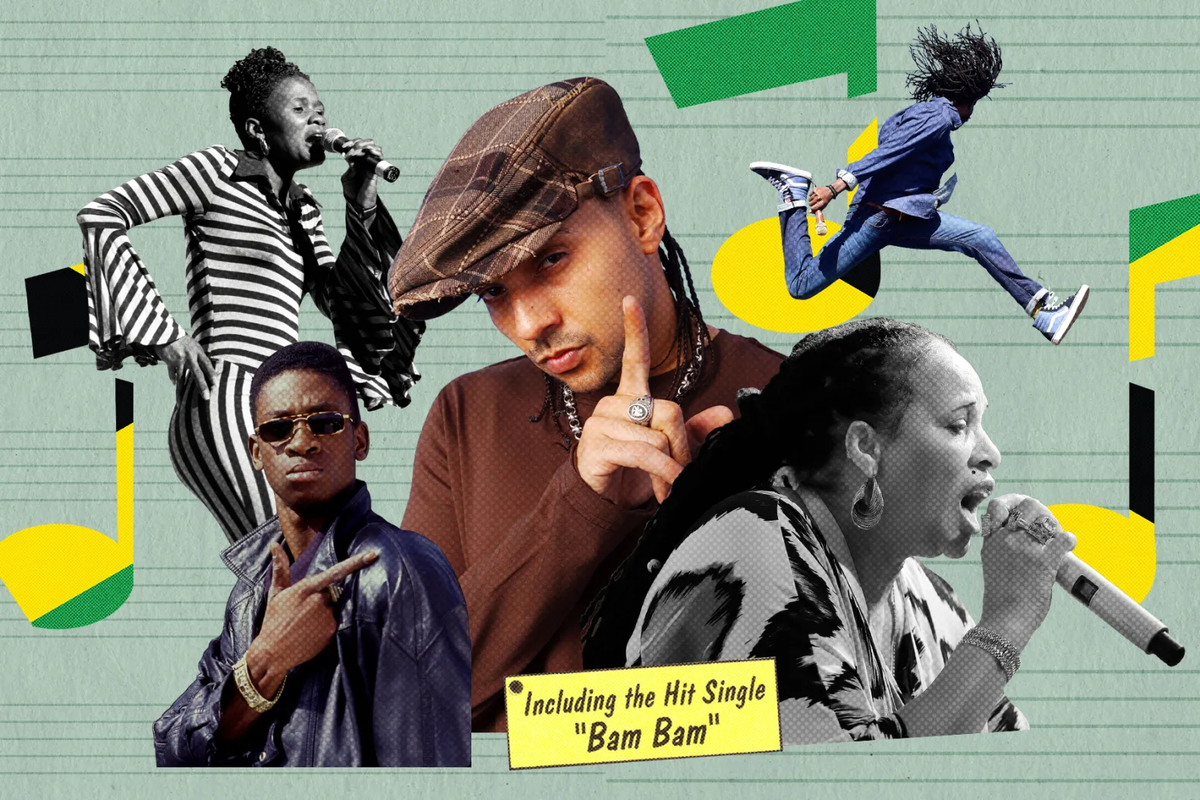
Since the 1980s, however, riddims started to be originally composed by producers and beatmakers, who give the riddims original names and typically contract artists to voice over them.
It is quite common for rhythms to be recycled and brought back into the collective consciousness years after their debut, often with an updated instrumental incorporating the latest production techniques, drum machines, synthesizers, or computer software.
The 30 Greatest Dancehall Riddims, Ranked
1. Sleng Teng (1985) | Producer: King Jammy / Wayne Smith / Noel Davey
No riddim changed Jamaican music more completely than Sleng Teng. The Sleng Teng riddim is widely recognized as the most transformative rhythm in the history of Jamaican music.
Introduced in 1985 through “Under Mi Sleng Teng” by Wayne Smith and produced by King Jammy, this digital rhythm marked a definitive shift from live instrumentation to computerized production.
It is said that “Sleng Teng” was originally created on a Casio MT-40 keyboard by legendary producer Lloyd “King Jammy” James and keyboardist Noel Davey.
Forged around a modified version of a rock preset, the riddim was first heard at an installation of Sting between soundsystems Youthman Promotion, Jammys, Black Scorpio, and Blackstar.
When it was played at a sound clash between Jammy’s sound system and Black Scorpio on February 23, 1985, it caused a musical earthquake.
The crowd went wild, demanding endless pull-ups. In an instant, the future of Jamaican music shifted.
The Sleng Teng riddim, named after the song in which it was first used, has now inspired as many as 450 different songs.
The riddim played a key role in bringing Jamaican music into the digital era, and is known as one of the “monster riddims” that ushered in the golden age of the dancehall era.
No longer was music restricted to expensive studio time and session musicians. Now, a youth with a keyboard could produce a hit song in a bedroom.
This democratization of music in Jamaica paralleled what hip-hop was doing in the Bronx with turntables and samplers.
Key Tracks: Wayne Smith “Under Mi Sleng Teng,” Tenor Saw “Pumpkin Belly,” Johnny Osbourne “Buddy Bye
2. Punanny (1986) | Producer: King Jammy / Steely & Clevie
The “Punanny” riddim, originally built by Steely and Clevie in 1986, has been voted “The Greatest Dancehall Riddim Ever” by an esteemed panel of judges from across the dancehall and reggae world.
That verdict was delivered on a special radio show hosted by acclaimed broadcaster and DJ Seani B on BBC Radio 1Xtra, produced to mark the eighteenth anniversary of the station’s launch.
King Jammy bagged the top two spots with “Punanny” and “Sleng Teng,” with the “Answer” riddim coming in third position.
The passage to find the ultimate riddim began with Seani B asking 50 key dancehall and reggae influencers, musicians, artists, writers, and producers from across the world for their top five riddims.
The irresistibly syncopated groove was created by celebrated musician and production duo Steely and Clevie, the late Wycliffe “Steely” Johnson and Cleveland “Clevie” Brown, who had significant input and influence on numerous dancehall riddims of the era.
Key Tracks: Admiral Bailey “Punanny,” Shabba Ranks “Caan Dun,” Beenie Man “Romie”
3. Stalag / Stalag 17 (1973) | Producer: Winston Riley
Named after the famous 1953 war film and originally released in 1973 on the prolific Techniques label, “Stalag” carries a heavyweight legacy in the genre.
This 1973 instrumental composition from Jamaican producer Winston Riley’s house band the Techniques All-Stars is certainly not the first riddim ever, but “Stagalag” helped establish the sound of dancehall.
Produced by Winston Riley, the Stalag’s composition is usually credited to Riley and keyboardist Ansell Collins.
However, veteran Jamaican drummer Carlton “Santa” Davis has claimed that Riley was not present at the recording session and that Collins only composed the riddim’s keyboard segments.
Santa contends he and his bandmates, including George “Fully” Fullwood, whose soul-shaking bass line dominates the riddim, remain uncredited and unpaid for their contributions.
The Stalag riddim went on to undergird classics like General Echo’s “Arleen,” Tenor Saw’s “Ring the Alarm,” and Sister Nancy’s “Bam Bam,” a 1982 interpretation of a Toots and the Maytals hit, and has been sampled on numerous tracks, including Kanye West’s “Famous” and Jay-Z’s “Bam,” featuring Damian Marley.
Riley revisited Stalag for a recording session in 1982 with twenty-year-old Ophlin Russell, known as Sister Nancy, who had been working with Yellowman at the time.
Key Tracks: Sister Nancy “Bam Bam,” Tenor Saw “Ring the Alarm,” General Echo “Arleen,” Super Beagle “Dust a Sound Boy”
4. Diwali (2002) | Producer: Steven “Lenky” Marsden
In 1998, Steven “Lenky” Marsden, a keyboardist in dancehall star Buju Banton’s band, created a beat out of swirling, syncopated handclaps, synth hits, and a winding sitar riff.
The track reminded Lenky of Bollywood musicals and Punjabi folk dances, and he called it the Diwali Riddim, after the Hindu holiday. For a few years, nobody wanted to record over the Diwali Riddim; it was too chaotic.
Steven “Lenky” Marsden’s Diwali Riddim landed in 2002 on Greensleeves Rhythm Album #27 and through 40/40 Productions, the label Marsden founded after years as a musician and sideman.
Three songs featuring Diwali, Sean Paul’s “Get Busy,” Lumidee’s “Never Leave You (Uh Ooh, Uh Ooh),” and Wayne Wonder’s “No Letting Go,” hit the top 20 on the Billboard Hot 100 during a three-month span in mid-2003, undeniably making it the defining beat of the year.
“Get Busy” was released internationally in 2003 and topped the US Billboard Hot 100 for three weeks that May. It also reached number one in Italy and the Netherlands, becoming a top-ten hit in an additional eleven countries.
The Diwali claps can be heard in Rihanna’s “Pon De Replay” and Brick and Lace’s “Love Is Wicked” from 2007, and the beat’s kick can be detected within Ed Sheeran’s “Shape of You” from 2017.
Key Tracks: Sean Paul “Get Busy,” Wayne Wonder “No Letting Go,” Beenie Man (Diwali album cut), Rihanna “Pon De Replay
5. Real Rock (1967) | Producer: Coxsone Dodd / Sound Dimension
The Sound Dimension band at Studio One, led by teenage keyboard prodigy Jackie Mittoo, created the evergreen Real Rock, highlighted by the meshed interplay of Boris Gardner’s rumbling bass, drummer Phil Callendar’s steady pace, Vin Gordon’s sly trombone, guitarist Eric Frater’s supple chords, and Mittoo’s irresistible three-note organ riffs.
The riddim landed in the BBC Radio 1Xtra panel poll at number five, confirming its standing across generations. The final positions from that poll placed Real Rock at number five overall.
Key Tracks: Sound Dimension “Real Rock,” Sugar Minott “Good Thing Going,” various Studio One artists
6. Bam Bam / Taxi (1982) | Producer: Winston Riley / Sly and Robbie
Not to be confused with Sister Nancy’s track of the same name, which rides the Stalag, the Taxi riddim produced by Sly and Robbie generated its own cluster of major versions.
Sister Nancy’s immediate inspiration to sing the popular phrase “bam bam” was hearing Yellowman and Fathead record their own version of “Bam Bam” over the “Taxi Riddim” in another studio just weeks before her own recording.
The cultural currency of the “bam bam” phrase across both riddims cemented this era as one of dancehall’s most creatively fertile.
Key Tracks: Chaka Demus and Pliers “Murder She Wrote,” various Sly and Robbie productions
7. Answer (1980s) | Producer: King Jammy
In the BBC Radio 1Xtra expert panel poll, the Answer riddim placed third overall, behind only Punanny and Sleng Teng, confirming its place among the most revered foundations in dancehall.
Flowing from King Jammy’s prolific stable, the riddim drew a deep vocal roster from the mid-to-late 1980s golden era.
Key Tracks: Various King Jammy productions from the digital era
8. Playground (1997) | Producer: Jeremy Harding
The Playground Riddim was produced in 1997 by Jeremy Harding and highlighted tracks including Mr. Vegas’s “Nike Air,” Spragga Benz’s “Strong Performer,” and Sean Paul’s “Infiltrate.”
The riddim arrived at the height of the late-1990s boom and became a proving ground for a generation of artists who would define the genre’s crossover moment.
Key Tracks: Mr. Vegas “Nike Air,” Sean Paul “Infiltrate,” Spragga Benz “Strong Performer”
9. Pepperseed (1994) | Producer: Dave Kelly
The Pepperseed Riddim, produced in 1994 by Dave Kelly, included highlight tracks such as Terror Fabulous’s “Number Two,” Daddy Screw’s “Model Pon Yuh Man,” and Daddy Screw’s “Big Tings A Gwan.”
Dave Kelly’s fingerprints on Jamaican music in the 1990s are enormous, and Pepperseed stands as one of his most celebrated constructions, anchored in a snapping, percussive low end that became a template for the decade.
Key Tracks: Terror Fabulous “Number Two,” Daddy Screw “Model Pon Yuh Man”
10. Golden Hen (1985) | Producer: King Jammy
Golden Hen placed sixth in the BBC Radio 1Xtra expert panel’s all-time ranking of greatest dancehall riddims.
Tenor Saw’s distinctive tone on hits such as “Golden Hen” made him a core favourite in the main centres of reggae across the world. The riddim exemplifies the energy and invention of King Jammy’s mid-1980s run.
Key Tracks: Tenor Saw “Golden Hen”
11. Showtime (1980s) | Producer: Various
Showtime ranked ninth on the BBC Radio 1Xtra expert panel list of the greatest dancehall riddims of all time.
A cornerstone of sound clash culture, the riddim’s driving energy made it a reliable weapon for selectors across multiple decades.
12. Up Close and Personal (1998) | Producer: Donovan Germain
The Up Close and Personal Riddim, produced in 1998 by Donovan Germain, featured highlight tracks including Tanto Metro and Devonte’s “Everyone Falls in Love,” Sean Paul’s “Nah Get Nuh Bligh,” and Beenie Man’s “Do You Wanna Diss.”
Germain’s Penthouse Records was one of the defining imprints of 1990s dancehall, and this riddim showcases the label at its most commercially effective.
Key Tracks: Tanto Metro and Devonte “Everyone Falls in Love,” Sean Paul “Nah Get Nuh Bligh,” Beenie Man “Do You Wanna Diss”
13. Bookshelf (Late 1990s) | Producer: Tony Kelly
The Bookshelf Riddim, produced by Tony Kelly, became synonymous with the late-1990s dancehall scene, backing tracks from artists such as Beenie Man and Sean Paul.
Tony Kelly’s production style bridged the raw digital era and the more polished crossover sound that would define the early 2000s.
Key Tracks: Beenie Man (Bookshelf cut), Sean Paul (Bookshelf cut)
14. Street Sweeper (1999) | Producer: Steely and Clevie
The Street Sweeper Riddim was produced in 1999 by Steely and Clevie, one of the most consequential production partnerships in the history of Jamaican music.
The duo’s ability to construct riddims with both rhythmic urgency and melodic sophistication is fully on display here.
15. Bam Bam (Stalag, Sister Nancy Version, 1982) as a Stand-Alone Cultural Event
While the Stalag riddim was addressed at number three, Sister Nancy’s specific 1982 recording of “Bam Bam” deserves its own notation as perhaps the single most-sampled moment in the entire dancehall catalog.
The song has been labeled a “well-known reggae anthem” by the BBC and a “classic” by The Observer. Jay-Z and Kanye West both borrowed from the Stalag riddim.
Sister Nancy has commented that she was oblivious to its impact until her daughter told her about it when it was featured in the 1998 film Belly, featuring DMX.
16. Who Am I / Zim Zimma (Mid-1990s) | Producer: Jeremy Harding
The riddim that backed Beenie Man’s “Who Am I” was produced by Jeremy Harding and introduced a more polished, electronic dancehall style in the mid-1990s, helping Beenie Man cross over globally.
The track became one of the defining anthems of the decade and gave the riddim a commercial reach that extended well beyond Jamaica.
Key Tracks: Beenie Man “Who Am I (Sim Simma)”
17. Filthy (1998) | Producer: Danny Browne
The Filthy Riddim was produced in 1998 by Haldane “Danny” Browne. Part of the dense wave of late-1990s productions that kept dancehall’s quality ceiling consistently high, Filthy generated a strong vocal roster and is remembered fondly by selectors of that era.
18. Sleng Teng Revisited / Digital Derivatives (1986 onward)
Following the massive success of Sleng Teng, dozens of digital riddims flooded the market. Riddims like Tempo, Punanny, Stalag, and Heavenless were reinvented using drum machines and synthesizers.
The lineage of Sleng Teng is so vast that its direct descendants constitute their own sub-category of greatness. This entry acknowledges that broader digital revolution as a single movement.
19. Freedom Blues (Multiple Eras) | Various Producers
Resurfacing in the 1990s, the Freedom Blues riddim was significant in that decade’s Rasta Renaissance in dancehall, as the sonic bed for Buju Banton’s “God of My Salvation” and the title track on singer Luciano’s 1995 breakthrough.
In the 1980s, producer King Jammy’s reissue of the beat yielded a major hit with Admiral Tibet’s “Serious Times,” followed by an even bigger remix of Tibet’s commentary, featuring Shabba Ranks and Ninja Man, produced by Bobby Digital.
Key Tracks: Admiral Tibet “Serious Times,” Buju Banton “God of My Salvation,” Luciano (1995 title track)
20. Ting a Ling / Gi-Gi (Early 1990s) | Producer: Steely and Clevie
The Gi-Gi rhythm, entering the 1990s, has been remade multiple times under various names. It demonstrates that recycling is an essential concept in dancehall culture.
Perhaps the most well-known version and the first is Shabba Ranks’s “Ting A-Ling,” which was produced by Steely and Clevie.
Key Tracks: Shabba Ranks “Ting A-Ling”
21. Bookshelf Through Tony Kelly’s 1990s Catalog (Honorable Mention Cluster)
Tony Kelly’s late-1990s output, including the Hot Wuk Riddim and related productions, represents a sustained period of quality that any comprehensive list of the best dancehall riddims must acknowledge.
His riddims backed some of the most commercially successful artists of the era and helped bridge the rawness of digital dancehall with radio-friendly production values.
22. Ring the Alarm (as Stalag Vehicle, 1985) | Winston Riley / Tenor Saw
While Sleng Teng sparked numerous versions, classic rhythm tracks made by traditional studio bands still dominated the dance, and top of the pile in the summer of 1985 was a funk-infused cut which a young MC known as Tenor Saw rode into the dance with his soundclash anthem “Ring the Alarm.”
In a rare interview in 1985, a nineteen-year-old Tenor Saw described how he originally came up with the lyrics at a sound clash between four different sound systems, Jammy’s, Arrows International, Black Scorpio, and Youth Promotion, the latter of which Tenor Saw was representing.
At the clash, Saw came up with the lyrics and performed them, leading Youth Promotion to victory.
Key Tracks: Tenor Saw “Ring the Alarm,” Sister Nancy “Bam Bam”
23. Murderer / After Dark (Mid-2000s) | Producer: Di Genius
Before 2006 ended, Kartel and Mavado began one of the most volatile feuds in dancehall history; some of their exchanged diss songs were recorded on Di Genius’s After Dark and Power Cut riddims.
The After Dark and Power Cut riddims therefore occupy a unique place in the lore of the genre: they are as much historical documents of a pivotal cultural clash as they are musical achievements.
Key Tracks: Vybz Kartel and Mavado diss tracks, various
24. Pepperseed Era / Dave Kelly 1990s Cluster
Beyond the Pepperseed itself, Dave Kelly’s overall mid-to-late-1990s catalog, including the Badman Riddim and related productions, represents the most concentrated run of quality dancehall production of that decade.
His signature snapping snare and thick low end defined the sound of Kingston dancehalls for nearly a full decade.
25. No Letting Go / Wayne Wonder (Diwali Vehicle)
Wayne Wonder’s “No Letting Go” became one of the most widely heard lover’s rock crossover hits of 2003 precisely because the Diwali riddim was flexible enough to carry both a ballad and a party anthem.
The Diwali Riddim worked so well in part because it was adaptable. In giving the track to different vocalists, Lenky would tweak the beat, adding or taking away different elements based on what suited the star best.
That is why the Diwali Riddim could work so well on a ballad like “No Letting Go” or on a party song like “Get Busy.”
26. Real Rock (Studio One Revivals)
The Real Rock riddim has been revisited across every decade of Jamaican music since its 1967 creation.
The unique nature of dancehall and riddims have been highly influential on the numerous remixes that now circulate throughout R&B and hip-hop music.
Real Rock is perhaps the clearest example of a Jamaican rhythm that has never stopped generating new versions, each one placing fresh vocal DNA on a foundation that has held firm for nearly sixty years.
27. Soca Crossover: Diwali and Caribbean Fusion Riddims (2002-2010)
As of 2026, a quick look through the musical soundscape of almost any world capital could hardly fail to encounter the sounds of dancehall, reggaeton, and ragga soca, whether anchoring the vocals of Drake, Bad Bunny, or Tyla.
The fusion riddims of the early 2000s, where dancehall producers began absorbing soca, hip-hop, and even South Asian instrumentation, created a new category of global pop music that owed its grammar entirely to the Jamaican riddim system.
28. Playground and Late-1990s Jeremy Harding Productions
Jeremy Harding’s late-1990s run produced some of the most commercially potent riddims of the era.
Beyond the Playground, his work with Beenie Man and the wider VP Records roster helped bring dancehall to new international audiences and prepared the ground for the crossover explosion that Diwali would complete in 2003.
29. Heavenless and the Post-Sleng Teng Digital Wave (1986-1990)
Artists like Tenor Saw, Johnny Osbourne, Nitty Gritty, and Super Cat rode the digital wave ignited by Sleng Teng, giving rise to the golden era of 1980s and 1990s dancehall music.
The Heavenless riddim, one of the prominent post-Sleng Teng digital constructions, is representative of the entire wave of machine-built riddims that flooded Jamaican studios in the second half of the 1980s and established the sonic language that every producer since has worked within.
30. My Conversation (Treasure Isle, 1968) | The Proto-Riddim
The honor of being considered the first riddim ever is usually reserved for the Uniques’ catchy “My Conversation” on the Treasure Isle label.
Without the rhythmic template established by this and other early Studio One and Treasure Isle productions, the entire riddim culture that produced every other entry on this list would not exist.
My Conversation closes this list as its foundation stone: the moment Jamaican music decided that a shared beat was not a compromise but a competition, and that competition was the highest form of art.
Key Track: The Uniques “My Conversation”
The Riddim in the Modern Era
These iconic riddims inspired generations of artists, fueled countless hits, and transformed the way dancehall and soca are heard around the world.
The best dancehall riddims of all time are not museum pieces. They are living structures, continuously re-voiced, remixed, and absorbed into new genres.
Sleng Teng was not just a sound; it was a cultural shift. It echoed far beyond Jamaica’s shores, influencing electronic music, reggaeton, grime, and even modern trap production.
The same could be said, in varying degrees, of every riddim on this list.
One of the most notable examples of Sleng Teng’s enduring global relevance came in 2021, when Facebook used the riddim in its global rebrand campaign to Meta.
The iconic bassline was featured in a high-profile television and digital advert, introducing Meta’s pivot into the metaverse, a major tech milestone soundtracked by one of dancehall’s greatest riddims.
The riddim format remains dancehall’s greatest gift to music production globally, and the thirty selections above represent the standard by which every new production entering the canon will ultimately be measured.