

If you are producing Caribbean music, building a DJ set, or simply trying to understand what separates one riddim from another, knowing the correct dancehall BPM range is the essential first step.
The short answer: dancehall typically runs 90 to 110 BPM, centered around 100 BPM. But that single number does not capture the full picture.
The Jamaican family of genres, reggae, ska, and soca, each occupy their own distinct tempo territory, and crossing those lines is how producers accidentally make a riddim that feels wrong before a single melody is placed.
This guide breaks down each genre’s BPM range, explains why the numbers differ, and gives practical starting points for your DAW.
Dancehall BPM: The Core Range
Tempo is one of the most important aspects of creating a dancehall beat. Classic dancehall is usually in the 80 to 100 BPM range, which gives it that laid-back yet dynamic bounce feel. However, the genre has shifted upward as it has evolved.
Dancehall typically runs 90 to 110 BPM, centered around 100 BPM. The BPM of dancehall and bashment is commonly 90 to 108 BPM, though faster forms also exist.
From a DJ perspective, the window is slightly tighter. Dancehall sits at 95 to 110 BPM in a DJ set, with most tracks around 102 BPM. Producers occasionally push outside that window, but 95 to 110 is the range you will actually meet at a gig.
Not all dancehall moves at the same pace. Production style and era both shift the tempo significantly:
- Roots-influenced, heavy riddims: Aim for 85 to 95 BPM.
- Modern club dancehall: 96 to 110 BPM is the standard range.
- Afro-dancehall and dancehall-pop crossovers: These sometimes push up to 115 BPM, but the core feel remains the same.
- Contemporary productions: Some newer riddims clock in at 120 beats per minute, and there is a heavy emphasis on melodies in the rhythm construction.
A working target for a producer building their first dancehall drum pattern: set your DAW to 90 to 95 BPM and adjust from there.
A common beginner mistake is conflating reggae’s slower lope with dancehall’s more energetic drive.
Many new producers accidentally set a dancehall beat at 70 to 75 BPM, confusing it with a slowed reggae feel. Dancehall typically runs 90 to 110 BPM, centered around 100 BPM. If your beat feels too slow, double-check your tempo.
Set your DAW to 4/4 time. The time signature for dancehall is 4/4. Inside that grid, the rhythm is built on syncopation.
Dancehall is based on a syncopated rhythm, which means that certain beats fall “off” the regular beat, creating an irresistible groove.
The kick pattern is the engine of that groove: the kick drum plays a syncopated pattern with hits on beat 1 and the “and” of 1, then beat 3 and the “and” of 3.
This is the engine of the groove: the kick doubles up in a way that propels the bar forward rather than anchoring it on the downbeat in the manner of a four-to-the-floor house pattern.
How Dancehall Tempo Evolved Historically
Understanding why dancehall BPM sits where it does requires tracing the genre back through its predecessors.
Since the early 1990s the classic roots-reggae rhythm, with its moderate tempo skank (approximately 60 BPM), has become less common than a faster 3+3+2 beat, as popularised by a new generation of producers.
The shift to digital production accelerated this. During the 1980s, drummer Lowell “Sly” Dunbar started incorporating electronic drums and samplers into his work.
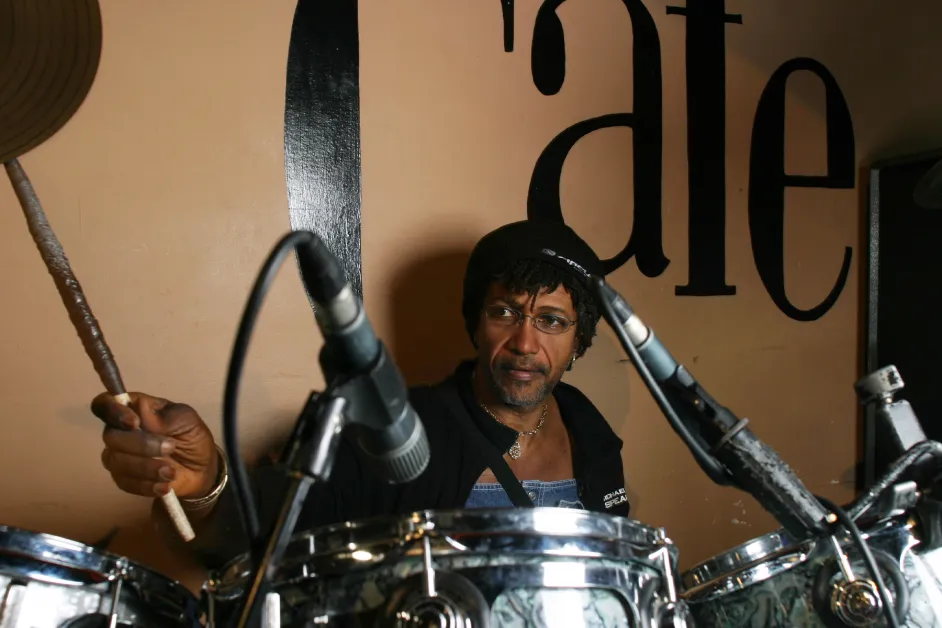
Speaking at a Red Bull Music Academy lecture in 2008, Dunbar said most Jamaican drummers were “scared” of drum machines, while he found them fascinating.
The adoption of those machines unlocked faster, more precise tempos that live drummers found difficult to sustain.
The 1990s saw riddims move further away from the skanking-friendly roots-reggae rhythm toward a faster 3+3+2 beat.
That architectural shift, not just a tempo change but a full rhythmic restructuring, is what separates contemporary dancehall production from its roots-reggae origins.
Reggae BPM: Slower Than You Think
Reggae is the parent genre, and its tempo reflects a different philosophy: depth over speed. Reggae typically falls between 60 and 90 BPM, creating its signature laid-back, groovy feel.
The slower tempo allows the characteristic offbeat guitar skank and deep bass to breathe.
Within reggae, tempo varies by subgenre:
- Roots reggae: Anchors around 70 to 80 BPM.
- Dub: Typically sits at the slower end, 65 to 75 BPM, to emphasize space and effects.
- Rockers: Usually run slower in tempo, around 60 to 90 BPM.
The classic reference point most sources converge on: 76 BPM is the classic reggae anchor. Skank guitar on offbeats only, kick on beat 3 (one-drop), bass leading the harmonic motion.
For roots reggae production, try something between 50 to 100 BPM and adjust as you go, depending on whether you want to build a riddim for a slow-, medium-, or up-tempo song.
Ska BPM: The Fastest in the Family
Ska is the oldest genre in the Jamaican lineage, and it is comfortably the fastest.
Ska is a Jamaican popular music style that emerged in the late 1950s and early 1960s, characterised by a pronounced offbeat guitar or piano “skank”, walking basslines, and punchy horn arrangements. It served as the direct precursor to rocksteady and reggae.
Ska’s BPM range depends heavily on which historical wave you are referencing:
- First-wave Jamaican ska (late 1950s to early 1960s): Original Jamaican ska often sits roughly between 120 and 150 BPM.
- Second-wave / 2 Tone (UK, late 1970s to early 1980s): 2 Tone tends to be 120 to 140 BPM.
- Third-wave / punk ska (1990s to present): Punk-inflected third-wave ska frequently pushes 150 to 190+ BPM.
The general SKA consensus from multiple production sources: the tempo of ska is typically around 120 to 140 beats per minute, although different styles can have tempos that are either faster or slower.
Generally, uptempo two-tone ska has a faster tempo of 160 to 180 BPM, while traditional ska and rocksteady have tempos ranging from 92 to 105 BPM.
This is why ska feels so different from reggae despite sharing Jamaican roots: the percussion is attacking and relentless where reggae is spacious and meditative.
Soca BPM: Carnival Energy in Numbers
Soca originated not in Jamaica but in Trinidad and Tobago. Soca music, or the “Soul of Calypso,” is a genre of music that originated in Trinidad and Tobago in the late 1960s and early 1970s.
It was created by Ras Shorty I (Lord Shorty) in an effort to revive traditional calypso, the popularity of which had been declining among younger generations in Trinidad due to the rise in popularity of reggae from Jamaica and soul and funk from the United States.
In tempo terms, soca is a high-energy proposition that spans a wide range depending on its subgenre:
- Groovy soca: The BPM for soca ranges from 115 beats per minute to 160 beats per minute depending upon the type of soca. If the soca is groovy, the beats per minute will most likely be 115.
- Power soca: If the soca is powerful then the beats per minute will most likely be 160.
- Overall range from groovy to road march: Soca has eight distinct substyles ranging from 90 BPM groovy soca to 150 BPM power soca road march anthems.
This gap between soca and reggae is one of the most dramatic in Caribbean music. Reggae BPMs typically sit in the 60 to 90 range; power soca can run nearly twice that. Dancehall is closer to soca in tempo and energy, and the two genres have cross-pollinated heavily, hence ragga soca.
Quick-Reference BPM Chart
| Genre | Typical BPM Range | Sweet Spot |
| Roots Reggae | 60 to 90 BPM | ~76 BPM |
| Dub | 65 to 75 BPM | ~70 BPM |
| Classic Dancehall | 80 to 100 BPM | ~90 BPM |
| Modern Dancehall | 90 to 110 BPM | ~100 BPM |
| First-Wave Ska | 120 to 150 BPM | ~130 BPM |
| 2 Tone Ska | 120 to 140 BPM | ~130 BPM |
| Third-Wave Ska | 150 to 190+ BPM | ~165 BPM |
| Groovy Soca | 90 to 120 BPM | ~115 BPM |
| Power Soca | 130 to 160 BPM | ~150 BPM |
Producer Tips: Setting the Right Dancehall BPM
1. Start at 90 to 95 BPM and move up. Most classic riddims live in this range. Push toward 100 to 108 BPM once your drum pattern feels settled.
2. Lock in tempo before anything else. Quantizing drum patterns to the wrong BPM after the fact will cost you hours.
3. Keep the arrangement minimal. Producing a riddim is a mix of precision and simplicity. Often they are minimal structures, with an emphasis on rhythmic repetition, leaving enough space for the vocals and lyrics to take center stage.
4. Think about playback systems. Dancehall is heard on massive bass systems. A sub-bass that sounds adequate on studio monitors may disappear entirely on a sound system. Set your tempo, then build bass accordingly.
5. Beware of half-time confusion. If a dancehall track feels unusually sluggish, check whether your software is reading it at half-time. A 102 BPM dancehall track can also be used half-time at 51 BPM or double-time at 204 BPM, all the same song, entirely different feel.
Dancehall BPM and Related Genres
Tempo is also where the influence of dancehall on global music becomes legible. Reggaeton grew out of dancehall riddims (notably the “Dem Bow” riddim), then settled at its own tempo around 90 to 96 BPM.
At 95 to 110 BPM, dancehall also shares tempo territory with Afrobeats, funk, and soul, which is why those genres can be beat-matched cleanly in a DJ set without touching the pitch fader.
Understanding dancehall BPM is not just a production technicality. It is a window into how Jamaican music first slowed down from ska’s frenetic pace, settled into reggae’s deep groove, then accelerated again into the digital riddim era that changed global pop. Set the right tempo and every other production decision becomes clearer.